17 Million Truckers’ Records are at the Center of a Massive Legal Battle
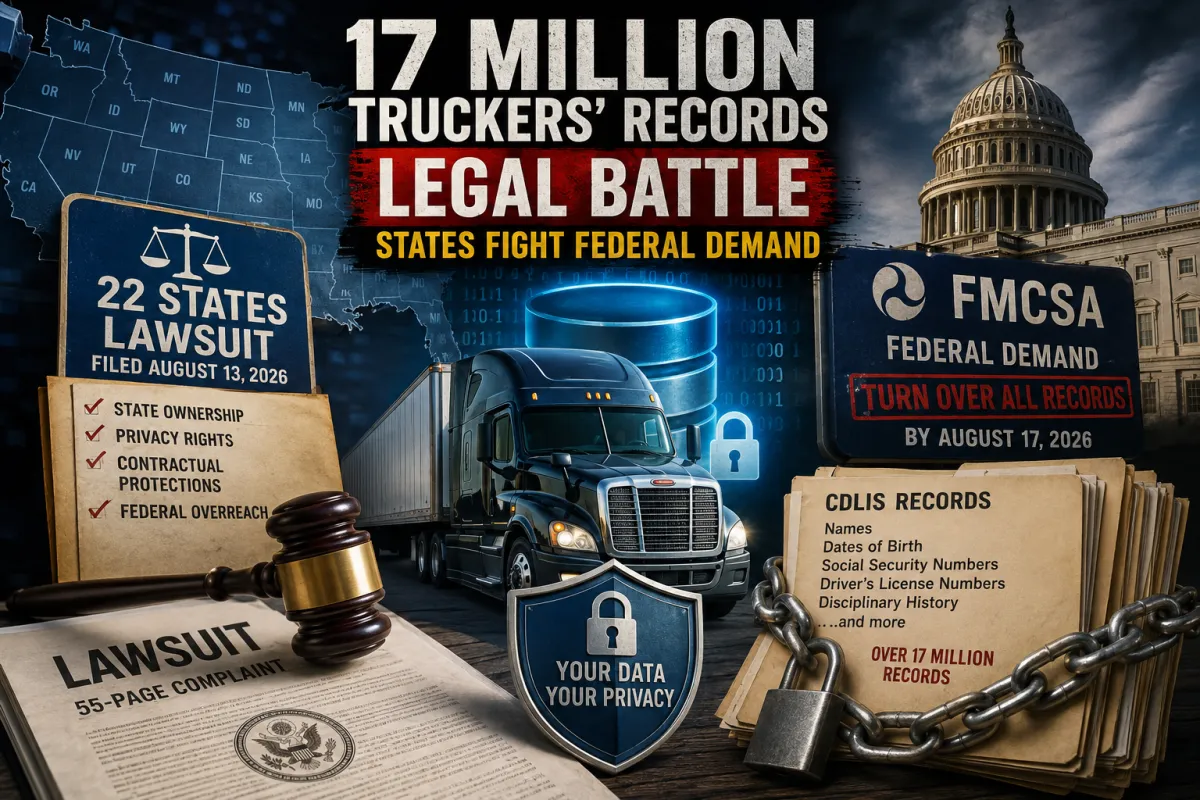
Some believe that the most recent demand from the federal government threatens the privacy of commercial truck drivers. Because of the invasiveness, 22 states have filed a 55-page lawsuit, started on August 13, 2026, with the federal government over their request for 17 million truckers’ records.
The legal battle over this has been described differently, depending on who’s describing it. It has some political elements to it. We hope to paint a picture of what’s at stake.
What’s Happening Right Now?
Congress passed the Commercial Motor Vehicle Safety Act in 1986. When they passed this law, they established the Commercial Driver’s License Information System (CDLIS), which gave states a way to share information about CDL applicants and ensure that they cannot hold a commercial driver’s license in multiple states.
If this were allowed, it would help drivers to avoid accountability for traffic tickets, driving suspensions, and safety disqualifications.
This database contains sensitive information with things like names, dates of birth, Social Security numbers, and driver’s license numbers. In total, it contains over 17 million records of driver information held by the American Association of Motor Vehicle Administrators (AAMVA).
The FMCSA demanded that this information be turned over by August 17th in full for every driver going back 5 years or they would terminate all federal contracts that the AAMVA held, meaning a loss of $10 million in federal funding.
Faced with losing this funding, the AAMVA could lose its organization altogether. They were caught in the crossfire with some states who didn’t want them to comply with the federal government. This is why when the AAMVA said it would hand the database over, 22 states filed a lawsuit, which was filed on August 13th.
Why Did the States File a Lawsuit?
You have two different views on this problem. You have the federal government’s view and the perspective of the 22 different states that filed the lawsuit. The states have no argument resting on a single point. Instead, they argue on several distinct objections, both practical and legal.
Their first argument is about ownership and consent. The states say that it is they, not the federal government, that owns the FDLIS data. They only placed this information in that system for a specific and shared reason, but they technically own the data individually on a state level.
The goal was to stop unsafe drivers. However, what the federal government is doing, they say, is putting the whole system at risk.
Another reason for the lawsuit is that several states have contracts in place with the AAMVA and the contracts explicitly say that there is to be no disclosure of this information without authorization from the state.
The next reason comes down to privacy law. Handing over that information without justification or privacy safeguards would violate confidentiality safeguards. There are also federal privacy statutes over how this information can be used.
How the Federal Government Sees It
DOT says that their case rests strictly on safety and enforcement of current laws. Getting access to this information, DOT says that their goal would be to keep unsafe truckers from driving. In particular, they want to identify the drivers who received improper licensing.
Secretary of Transportation Sean Duffy had strong words for this and said that ultimately this is coming down to states wanting to protect illegal immigrant truckers who drive a big rig.
Since April 2025, DOT has revoked over 30,000 CDLs that were improperly issued. In addition, 10,000 fraudulent and unqualified trucking schools were removed from the federal registry. Over 26,000 drivers who didn’t pass the English proficiency tests were placed out of commission.
States Participating in the Lawsuit
There are over 22 states participating in this lawsuit, so we’re not going to go over all of them, but we will name a few. The states involved in the lawsuit include:
California
Illinois
New York
Minnesota
Pennsylvania
New Jersey
Washington
Massachusetts
Michigan
Arizona
After the lawsuit was filed, U.S. District Court Judge Anthony J. Trenga effectively stopped all parties from moving forward with their demands until after the lawsuit is resolved. He froze the transfer of the bulk of this data until the lawsuit is resolved.
How Does This Impact You?
Anyone who holds a CDL is in this database of 17 million truckers. In the immediate term, no one will feel the impact of it. The data has become the center, however, of this massive legal battle. If you care about what happens with your information, it may give you reason enough to follow it.
Ultimately, this is a battle over who controls your data. Will the states have control over this information or will the federal government? The outcome of this case will shape how driver information is shared for years to come.
You may also belong to a group of people who worry that if this information gets turned over to the federal government, it will create a massive federal tracking pool and erode your privacy. You may also face greater scrutiny over your CDL if you went to one of the CDL mills.
What Do You Think of This Legal Battle?
Ultimately, whatever happens with this legal battle, it will square away the issue of who controls your data as a trucker. Does the federal government have control over this information, or does the state have control?
What’s your opinion of this case? Who do you think should have control over your personal information? Let us know in the comments, and we’ll have an active discussion.