Truck Driver Jobs: How to Compare Pay, Home Time, and Benefits
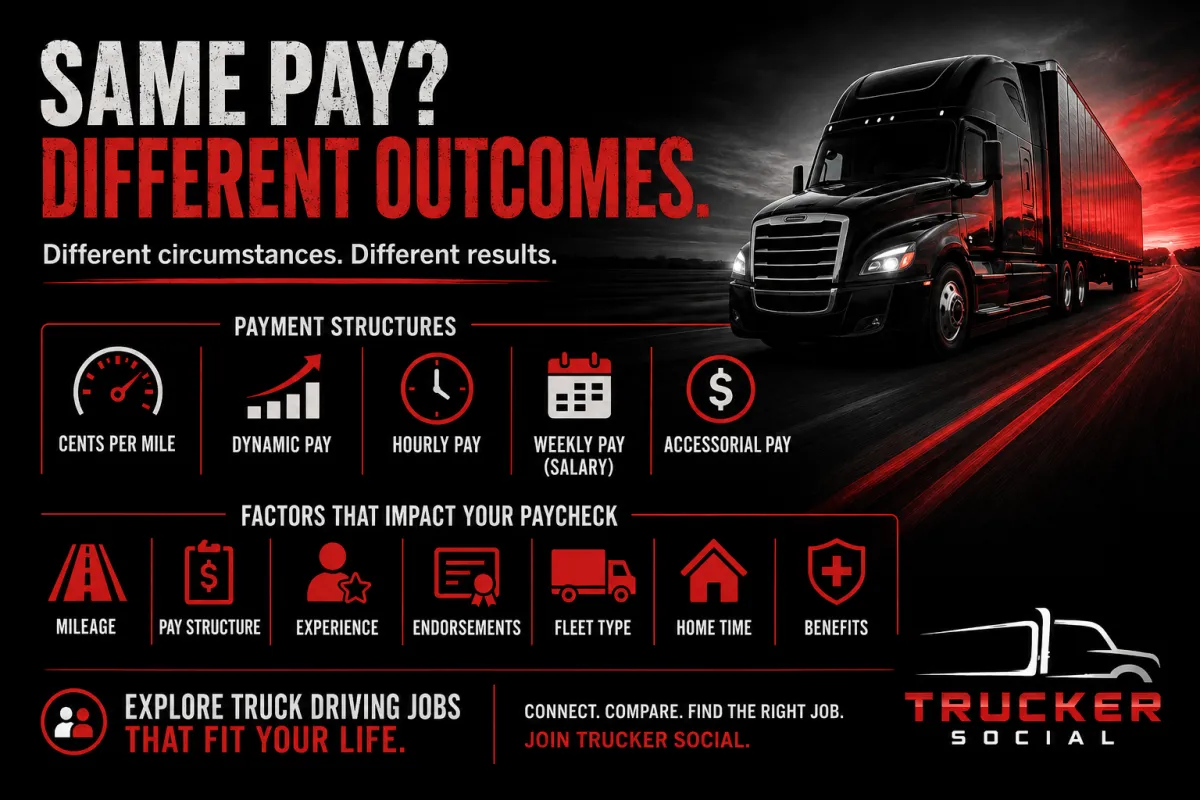
When it comes to driving truck, comparing the pay can be hard because you can put two truckers next to each other with the same pay, and their circumstances will be entirely different. They might be paying different expenses, and they could be spending different amounts of time at home. This is why truck driver jobs can be difficult to compare.
Looking at the multiple factors is part of what makes it so hard to compare the job. You have many things to look at, like percentage of revenue, mileage, stop pay, detention, bonuses, and layover. Everything can change the outcome, so even if you see the same pay rate for two different drivers, they may have completely different circumstances.
We’re going to take a look at how truck drivers receive payment, and we’re also going to look at payment structure. You’ll be able to tell better by the end the differences between the jobs, even with the same pay, when you explore truck driving jobs.
How Do You Compare Payment Structures?
To do it well, you need to understand the different factors. Then, make sure you check the fine print. To a degree, you also need to look at what would be most preferable for your own situation. Some truckers prefer a certain payment structure because it fits their situation better than others. Trucking driving jobs that pay $3,000 a week say less about the job than the overall payment structure.
You need to look at what you’re trying to accomplish. Also, from whatever you receive, subtract any of the recurring costs that you will need to pay for ongoingly.
Trucking Payment Structure
When it comes to trucking, most discussions on driver pay will center on either annual earnings or gross weekly. Depending on how the trucking carrier structures the payments, it can mean completely different things. Let’s look at a few things to better understand how this works.
Cents Per Mile (CPM)
Cents-per-mile is the most common pay structure you will encounter for over-the-road (OTR) truckers. What it means is that for every mile you drive, you receive a set rate. You need to pay attention, however, because the details matter. For example, will they pay the same for empty miles and loaded miles? How do they calculate the route mileage?
Most OTR national trucking carriers will send you out on between 2,300 miles and 2,600 miles every week. On average, trucker pay ranges anywhere from $0.50 to $0.75 per mile. Owner-operators typically earn anywhere from $1.80 to $3 per mile. However, owner-operators need to cover all their expenses, whereas those employed by a trucking carrier will have all their expenses paid for by the carrier. This is how carriers tend to structure cents-per-mile pay.
Dynamic Payment Plans
With this payment structure, you’ll receive a mileage-based structure, but then they’ll reward you for the length of your haul, the type of freight, and how much time it took. This differs from a flat cost-per-mile pay structure because of that. You also receive a reward for your time and performance.
Hourly Pay
This is exactly what it sounds like, and you will receive a set pay for the number of hours that you spent doing the work. They don’t tend to offer this with OTR trucking. The first two are OTR trucking, but the third one is most common with local trucking jobs. When you need to wait at a loading dock, when you’re sitting in traffic, when you’re handling freight, all of this counts toward your pay.
If you don’t want to make frequent stops, hourly pay is not a great choice. You will make far more frequent stops when doing truck driver jobs with hourly pay. Hourly pay can generate a good income for you, and the pay typically ranges from $24 to $32 per hour.
Flat Weekly Pay
Some truck driving jobs will give you a flat weekly minimum. You just need to meet the requirements to receive the pay. With this one, you should stay aware because some of them will require no performance issues, like late deliveries. You’ll also hear this one referred to as salary pay. For drivers, you get better stability, and it makes it easier for you to do budgeting back at home.
Salary pay is also better for winter driving because you often need to slow down due to icy roads.
Activity Pay / Accessorial Pay
Many drivers overlook this, and it can wind up costing you money. For example, if you only get paid for miles, you won’t receive anything while sitting at the loading docks. You need to watch out for this one because a carrier that advertises a higher CPM might cause you to earn less because of the time spent waiting.
This covers company driver payment structure, but if you're considering going owner-operator, you may want to read this article first comparing company drivers versus owner-operators.
What Things Influence Your Weekly Paycheck?
You have a few different factors that you need to pay attention to, like:
Mileage
Pay structure
Experience level
Endorsements
Fleet type
If you're curious about how to find the best CDL jobs, check out the article we wrote here!
How Much Home Time You Get
There are trucking companies that will keep you out on the road for several weeks at a time, so you need to consider this carefully. New truckers have less room for negotiation and often wind up doing OTR trucking at least in the beginning. Here’s what the average home time looks like:
Local trucking: Home every night, but you often receive less pay than OTR or regional. It’s hard to get for new truckers. These are not the truck driver jobs with no experience.
Regional trucking: For regional, you tend to come home quickly, and in some cases, it might even be a little more than that.
OTR trucking: With over-the-road trucking, you come home once every 3 to 4 weeks. For every week you spend on the road, you typically get one day of home time.
Owner Operator: One of the nice things about being an owner operator is that you can choose how long you want to be out based on your personal goals and expenses.
See more about driver home time and how often they get off here.
The Benefits You Receive
You also want to look at benefits like paid vacation, health insurance benefits, predictable bonuses, and retirement contributions. Always verify whatever a recruiter tells you. You want to speak with drivers who have worked with that company to see how they liked it. Ask them things like:
Average mileage in the last quarter
Unpaid hours spent waiting
Frequency of your weekend dispatch
Finally, if you see a signup bonus, ask the truckers how many of them received their bonus. There are companies who make an attractive-looking signup bonus, but when the trucker goes to claim it, they find themselves disqualified.
Explore Truck Driving Jobs at Trucker Social
At Trucker Social, we have a job board and a place for networking with recruiters who can help you to find the best truck driver jobs. You can also network and speak with other drivers from that company to see how well they treat their drivers. Check us out, sign up, and explore truck driving jobs that would be a good match for your situation.