How to Become an Owner-Operator: A Practical Start-to-Finish Guide
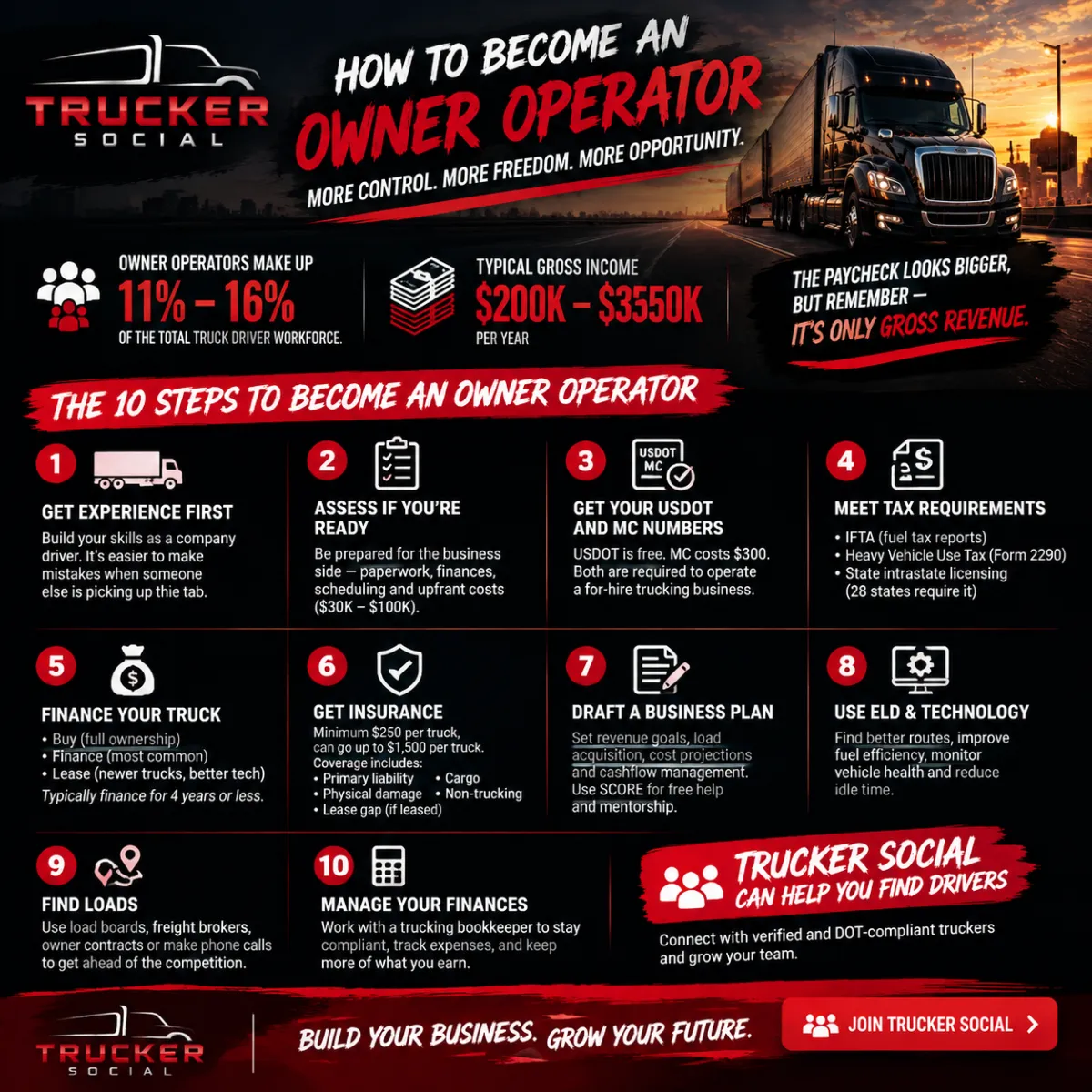
Did you know that owner-operators account for between 11% to 16% of the total truck driver workforce? One of the biggest reasons for this is that the typical owner-operator grosses anywhere from $200,000 to $350,000 per year. That number looks attractive. However, it only shows you gross revenue, and many truckers' take-home pay will be much less than that. Depending on how you manage it, it can wind up looking similar to a company driver.
We highlight that not to discourage anyone, but we think it's important for you to understand what you get when you go owner-operator. When you go owner-operator, you want to do it for the right reasons.
Going owner-operator as a small business especially makes sense when you want the freedom. When you want to be home for Christmas or for your kid’s basketball tournament, being an owner-operator gives you the power to do that. With that said, let’s look at how to become an owner-operator.
Get Enough Experience First
We never recommend someone who just graduated from trucking school to become an owner-operator. The reason behind it being that you lack the experience to do it well. You need even more skills as an owner-operator than you do as a company driver.
As a company driver, you need to get the load from point A to point B. When you go owner-operator, you need to get your own loads, you need to pay your own insurance, and if you get fined or sued, it’s no longer the company you work for getting sued. It’s you. This is why it matters so much to get the experience first because it’s easier to make big mistakes without experience.
When you first start trucking, you will make mistakes, and you want another company to have to deal with those mistakes rather than having to pay for them yourself.
Assess if You’re Ready for It
After you’ve been trucking for at least a year or two and we would recommend more, you need to realistically assess if you’re ready to handle the business side of trucking. You will need to manage your own paperwork, finances, and scheduling.
Some owner-operators do it to be home more, but what they often find is that they need to be working more, not less. Where it differs is that you can be home more when you want to be home. Your carrier can’t tell you that you need to be in Kentucky hauling grain that weekend.
Be aware, however, that 82% of owner-operators report their family life as being affected. You will also need to have access to capital or financing before you can start.
Your upfront costs will be anywhere from $30,000 to $100,000, depending on you. Here’s what the cost to become an owner-operator looks like:
Truck down payment—$5,000 to $20,000.
Insurance down payment—$2,000 to $5,000
Filing & legal fees—$500 to $1,500
Permits & registration—$1,500 to $3,000
Equipment & tech—$500 to $1,500
Emergency cash reserve—$15,000 to $30,000
Before you start, you also need to be even more aware of the federal and state trucking laws to ensure compliance.
Get Your USDOT and MC Numbers
In order to operate as a for-hire trucking business, you need your USDOT number and you need your Motor Carrier (MC) number. You need them both to be able to operate:
USDOT Number: Your USDOT number tracks your safety and compliance. It works as your official company ID, and you display it on the side of your truck. You can get this for free from the FMCSA DOT page. Never buy or sell these numbers since they can’t be transferred.
MC Number: Having an MC number grants you the ability to transport regulated freight across state lines. One thing to know about this is that they’re no longer issued separately, but you still need to apply for each one on their own. You can get your MC number here.
While the USDOT number is free, the MC number will cost you a $300 filing fee. Some companies will try to charge you for this, but you can fill it out directly on their website.
Regulatory Tax Requirements
When you file your taxes, you will need to meet the owner-operator small business requirements. Things to keep in mind include:
International Fuel Tax Agreement (IFTA): You must keep a record of where you fueled up going back 4 years if you drive interstate. You file your fuel tax reports every quarter. If you fail this one, they can revoke your IFTA license, preventing you from traveling across state lines. At the first weigh-in station you come across, they will ground your truck, and they’ll do it to your whole fleet, so you want to keep this up.
Heavy Vehicle Use Tax: If you drive a truck over 55,000 pounds, you need to fill out IRS Form 2290 every year, and you must pay a tax based on the weight of your truck. It’s $100 for vehicles at 55,000 pounds, and for trucks over 75,000 pounds, you may need to pay $550.
State Intrastate Licensing: One thing you don’t need to worry about as a company driver is getting licensing. When you drive truck for yourself, 28 states require either a permit or a registration for in-state commercial trucking. Check before you drive through that state. Typically, your state application fee ranges from $50 to $250. Be aware of annual renewals.
How Will You Finance Your Truck?
You have three choices when it comes to financing your truck. You can choose to finance, you can choose to lease, or you can choose to buy it. If you buy it outright, this requires a lot of capital outright, but you get full ownership of the truck, and you have equity.
Besides buying, you can also finance your truck. Most owner-operators choose to finance their truck. Normally, this means that you look at loans and try to find one with the best interest rate. You typically take out a loan for 4 years or less. Financing also lets you preserve your cash flow, which is essential for any trucker. Also, you will own the truck fully once your loan ends.
Finally, you have to lease a truck. Why would anyone choose to lease a truck when they won’t own the truck at the end of the term? One of the big reasons is that at the end of the lease, you can get a new truck. Oftentimes, you can get a better truck than what you could’ve gotten if you had financed or bought it outright.
Your equipment will also often be more reliable. Newer models usually have better fuel efficiency and more modern safety features.
Get Insurance
You need insurance before starting trucking, and at a minimum you will pay $250 per truck, but it can go all the way to $1,500 per truck. The coverage you need includes:
Primary liability
Lease gap coverage (only if leased)
Non-trucking liability
Physical damage
Cargo insurance
How much will also depend on which state you come from.
Draft a Business Plan
When you work as a company driver, you don’t need a business plan. When you work as an owner-operator, you need to include things like revenue goals, load acquisition, cost projections, and cash flow management.
Having a business plan can help you get a loan. You can also use it to survive financially and see how you’re progressing with your business.
You use the business plan for managing yourself, for operating your business, and for recruiting new truckers to your business. Let’s say that you need help doing this. You can actually use SCORE to create a business plan for free. This is also a great place to find a mentor who’s a retired business leader.
Use ELD and Other Technologies
You will find few truckers who can say a positive word about ELD regulations, but since we have to use them, we might as well use them to our advantage. You can use ELD to find the shortest and most fuel-efficient routes. Truckers also use it to perform preventative maintenance by looking at vehicle health reports, and they can use it to lower their idle time.
Finding Loads
We’re getting almost through how to become an owner-operator, but one thing you need to do here is know how to find loads. You don’t need to do this as a company driver. The most common places to find loads are on load boards, through freight brokers, and through owner-operator contracts. Some people will also put out phone calls because it can put you at the front of the line before other carriers can even target the load.
Manage Your Finances
As an owner operator, we would strongly advise you to get a specialized trucking bookkeeper. The reason is that the trucking landscape is complex, where you need to manage per diem, mileage, heavy vehicle use taxes, and settlements, and it’s easy to fall out of compliance. Managing the paperwork can also cut into your driving time, which is what makes you the real money. Consider it an investment that will also save you from hefty fines.
Trucker Social Can Help You Find Drivers
Hopefully, this shows you how to become an owner operator. If you’re an owner operator and you’re successfully running it solo, you can now use Trucker Social to recruit other drivers to work for you and earn even more money. One of the great things about going through us is that we give you access to verified and DOT-compliant truckers.
Join our trucking community of owner operators to connect with seasoned professionals and discover how to build a money-making trucking empire.