TAT’s Harriet Tubman Award Winner Arian Taylor Speaks: What He Saw That Most Truckers Missed
The trucking industry serves as the first line of defense against human trafficking. Arian Taylor, the winner of TAT’s Harriet Tubman Award in 2018, recently spoke about the critical role commercial drivers can play in fighting back against human trafficking.
Those working in transportation are now being trained to spot the signs of human trafficking victims to save lives. Arian Taylor encourages truckers to participate in the specialized training programs to help drivers learn to spot it.
He would go on to say that every human being should have freedom, and he loved being identified with a freedom fighter like Harriet Tubman because it enriched his life to keep that fight alive no matter what the cost.
What is TAT’s Harriet Tubman Award?
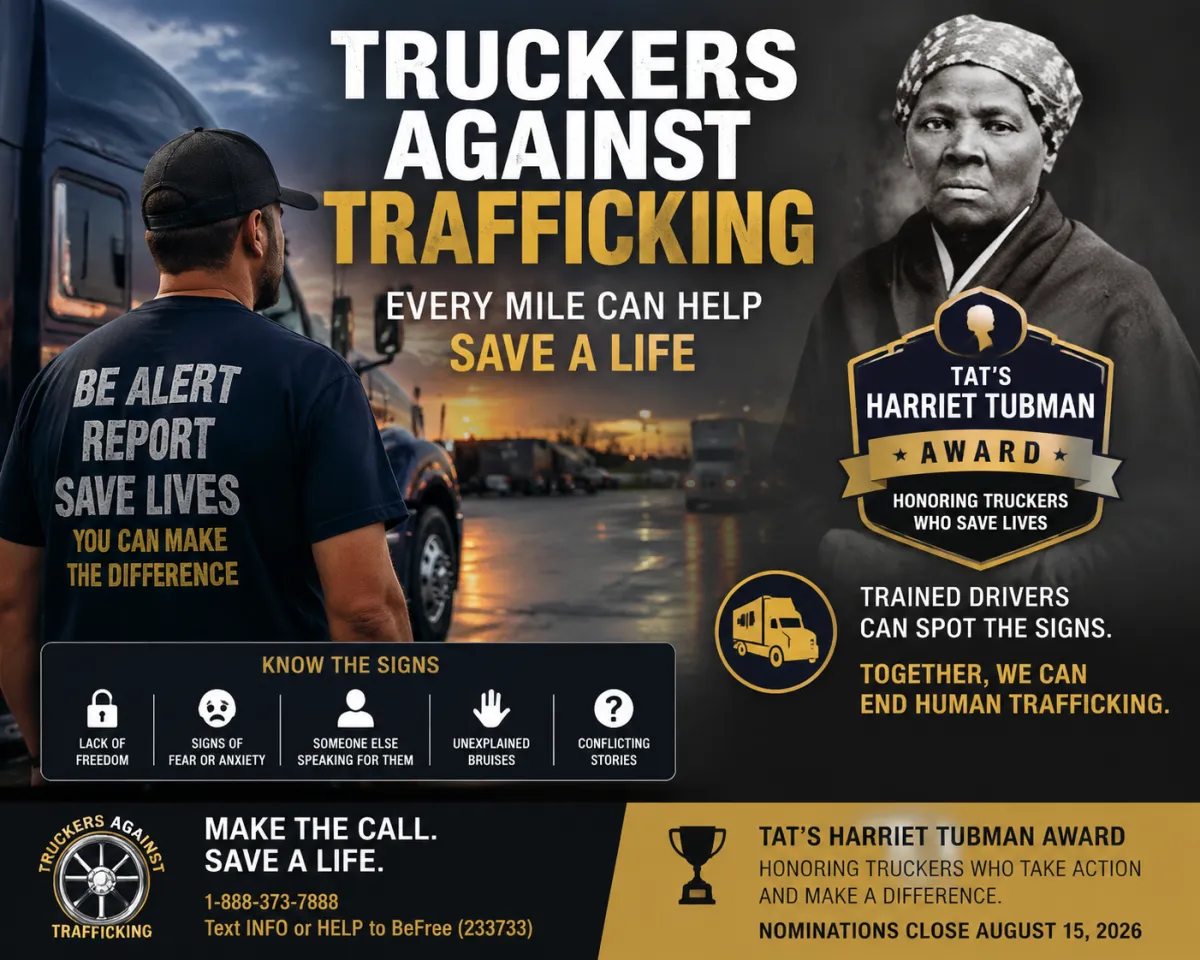
For those unaware of TAT’s, it stands for Truckers Against Trafficking, and the Harriet Tubman Award is an annual award given to truckers who directly saved the lives of those caught in human trafficking.
The award comes with a $5,000 cash prize, and it was first created in 2013 to fight back against human trafficking, since truckers are uniquely positioned to help. The nominations closed this year on August 15th, making it the 13th award given.
Arian’s Thoughts on the Unique Position to Fight Human Trafficking
Arian Taylor won the TAT’s Harriet Tubman Award in 2018 when he helped a woman escape from an attempt to force her into human trafficking.
When he was asked why he thinks truckers are uniquely positioned to recognize and report human trafficking, he would tell them that he believes truckers are literally everywhere on the road. You can find them on the city streets, neighborhoods, everywhere.
We deliver everything by truck, which means that we see things that other people don’t. Truckers also tend to be in the areas where human trafficking takes place, right along the highways.
The other thing is that many human traffickers don’t realize that truckers can catch them in the act just as easily as law enforcement, but while they might be looking out for law enforcement, many aren’t watching for truckers.
Why Taylor Believes Training Matters so Much
Taylor said he believes that the training resources TAT provides arm drivers with essential tools and knowledge that they can use every day they’re in the truck. He would continue by saying that truck drivers are as large as any military and when focused on fighting against human trafficking, they become a powerful force for saving lives.
He would continue by saying that truckers need to occasionally rewatch those videos or take the TAT’s refresher training to keep themselves up to date.
How Taylor Was Impacted by the Human Trafficking Victim He Saved
When he came across the female victim of human trafficking in 2018, Taylor would say that it changed his life forever. Until that moment in time, he said that human trafficking didn’t feel real. That underlines a common thread because most people feel this way, even those who aren't truckers. It’s a crime that often goes unnoticed. You hear about it, but you rarely think about it.
He said he knew deep down this was someone’s child, and he needed to take them away from the danger as quickly as possible and figure out how to get them home.
He said that before this incident, he may have come across runaways and he tried to help them, but he didn’t know if they were trafficked or simply runaways. All of this was because he wasn’t aware that it was happening.
That’s where TAT’s has been so crucial with its education of truckers, and this is one of the biggest reasons that Taylor says he supports them.
What Do You Think of TAT’s?
Arian Taylor is only one example of a trucker who has helped the victims of human trafficking. Every year, a new trucker wins the TAT’s Harriet Tubman Award. Since 2013, there have been 13 awards given so far.
We would love to hear your thoughts on TAT’s and if you have received the training to help you spot human trafficking victims. Maybe you have a story about seeing a victim of human trafficking. What happened and how did you respond to it? We would love to hear your story. Leave a comment below.