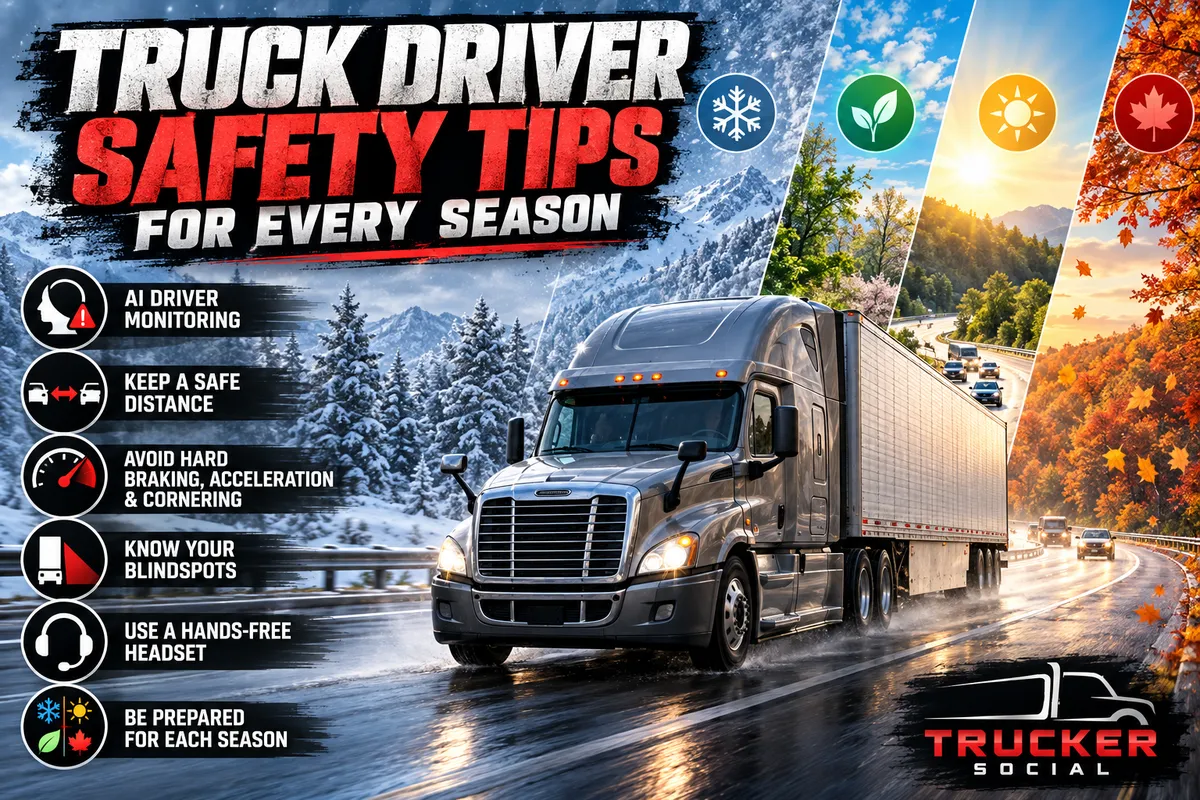
Truck Driver Safety Tips for Every Season
When you drive truck for a living, you face unique safety challenges. You haul a 53-foot trailer, and it leaves you with little room for error. One mistake can kill people, so it’s a big responsibility. Each season poses its own set of challenges as well. You spend long hours behind the wheel every day, and regardless of whether you will make your first truck drive or your thousandth, you need to pay special attention during each drive.
In 2025 alone, there were 4,047 fatal crashes involving semi-trucks. Of those crashes, there were 4,506 total fatalities in 2025, involving semi-truck crashes, according to the FMCSA. At Trucker Social, we understand the importance of safe truck driving. That’s why we thought we would put together a list of truck driver safety tips to help you stay safe for every season. Some of these trucker safety tips could save lives.
Tip #1: Install an AI-Powered Driver Monitoring System (DMS)
One of the biggest problems with driver fatigue is that you don’t recognize it until you fall asleep at the wheel and smash into the car ahead of you.
Having a DMS system will monitor things like distraction, driver fatigue, and microsleeping. It catches it and alerts you before you fall asleep and harm yourself or someone else. The monitoring unfolds in real-time through in-cabin sensors that track eye movement, blink rates, head posture, and facial micromovements.
The DMS adopts a proactive approach to safety to stop you from getting into an accident to begin with.
Tip #2: Follow Other Cars from a Safe Distance
This is a good one as far as CDL driver safety tips go. Semi-trucks stop in a way that is 40% slower compared to regular cars. Considering how circumstances on the road can change in the blink of an eye, you need to keep a safe distance from other vehicles to ensure that you can stop in time.
You want to give yourself a 4-second stop gap between yourself and the car or truck ahead of you. When you drive in bad weather, make it 6 or 8 seconds, depending on how bad the weather is. This gap protects you from getting trapped in the event of a pileup or a sudden obstacle on the road.
Be aware as well when near areas with heavy pedestrians. Crosswalks and other areas can be dangerous.
Remember: When you drive 65 mph, it takes an average of 2 football fields to come to a complete stop. Follow this commercial truck driver safety tips, and you’ll lower your risk of having an accident.
Tip #3: Hard Braking, Hard Acceleration, and Hard Cornering
See how high diesel is right now? Not only will you have to pay more in diesel, but it poses a danger, also. Most of the time, drivers who do one of these things will do all three. It reflects on your driving habits. The biggest problem is that this shows that you prioritize speed over safety. You may not be paying the most attention when you take on one of these habits.
You want smooth and controlled operation to guarantee the maximum level of safety. Now, there are times in trucking where you need to do those things, but if you find yourself doing these things all the time, you could be setting yourself up for an accident.
Tip #4: Know Your Blindspots
Truckers deal with more blindspots than regular cars. You have four main blindspots called the no-go zones. You have the head-on blindspot dealing with anything 15 to 20 feet ahead of you, you have the rear-view blindspot, extending 30 feet behind your trailer, your driver’s side, and the passenger’s side.
The passenger side is the most dangerous because it can stretch across 2 or 3 lanes. Whenever you change lanes, know where the other cars are, and if you’re in heavy traffic, exercise even more caution.
Tip #5: Use a Headset When Talking over the Phone
Many truckers talk on the phone for a few hours per day to keep the boredom away and to socialize. However, there’s a right way to do it and a wrong way. The wrong way is where you hold the phone up to your ear while driving, and it causes you to drive distracted. Having a hands-free headset lets you use the phone safely and talk while driving without distraction.
Cell phone use is restricted under the FMCSA because it can cause you to drive distracted when you go to reach for the phone. Hands-free calling is allowed, however.
Tip #6: Know the Risks of Each Season
Depending on where you drive, the risks will be more or less pronounced. Winter has snow and ice, and driving when it’s snowing can be a slippery ride. Even in the spring, don’t relax too much because ice you can’t see, also known as black ice, can still be found on the road. Especially beware of it being on bridges, since this is one of the common places that you encounter black ice.
Bridges ice often like this because of the lack of ground insulation. They will also have airflow coming from the top and bottom of the bridge, causing it to freeze over.
During rainy weather beware of the risk of hydroplaning. Hydroplaning can occur at speeds as low as 35 mph. Also, beware of having a light or empty trailer during this time because it can cause you to lose your grip on the road and jack-knife. To deal with it, slow down in heavy rain.
One of the dangers during the fall season is deer being out on the road, especially in the early mornings or around sunset. Don’t try to swerve to miss a deer because this often causes a worse accident than if you went straight forward and hit it.
Share Safety Lessons in the Community
Hopefully, this gives you a few new truck driver safety tips that you can start using to stay safer when driving on the road. At Trucker Social, we have a thriving community of truckers. Whet[her you’re a beginner who wants to get advice from the pros or you’re someone with a lot of experience and want to share safety tips, we would invite you to sign up for a FREE profile on Trucker Social. You can start participating in an active community made by truckers, for truckers.