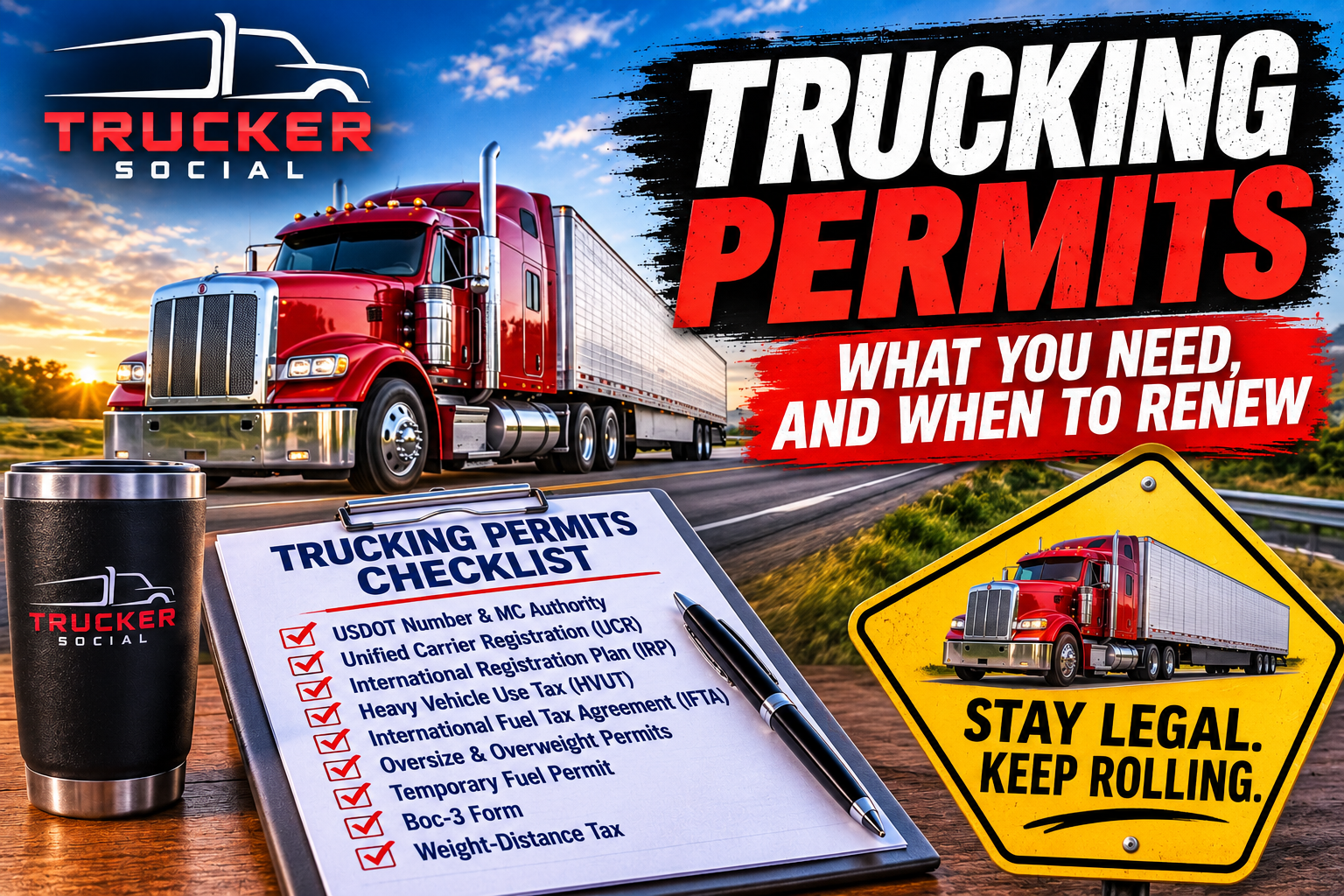
What Trucking Permits Do You Need for Your Operation?
Before you ever become an owner-operator, you need to know about the trucking permits. Trucking permits give you what you need to run legally. The hardest thing about truck permits has less to do with filing them, but keeping up with them. For example, you need to know which one applies and when it renews.
With some permits, you only need to file for them once. Other permits require you to file every year. You also need to know when each one applies for your lanes, trucks, and freight. When starting a trucking company, setting up your USDOT number and MC authority are only the beginning.
1. USDOT Number and MC Authority
This is one of the truck permits that DOT issues. Most owner-operators need to register an USDOT number and an MC authority. If you run interstate cargo, you need an USDOT number. Commercial vehicles over 10,001+ pounds need an USDOT number. You also need it if you plan to transport hazardous materials. The USDOT number tracks your safety and inspection records. Getting an USDOT number is free. You can apply for one here.
Keep in mind, you need to update your USDOT number every 24 months, or there is a fine of $1,000 per day (up to $10,000). Luckily, this one costs nothing.
To run your own trucks, you also need to register an MC authority. You need to register an MC authority if you plan to transport freight across state lines. Your MC authority defines for-hire business activities and what you specifically plan to run. While your USDOT number costs nothing to apply for, your MC authority has a filing fee of $300. You can apply for it here.
After you file your MC authority and pay the $300 filing fee, you never need to pay the fee again, but you do need to keep your information updated every 2 years.
2. Unified Carrier Registration (UCR)
Anyone who hauls loads across state lines to participate in interstate commerce needs to get their UCR. For trucking permit cost on this one, you need to renew it every year. If you don’t get it, the penalties reach up to $1,000 per state. In 2025, they required it for 41 states, so most states will require it. Check to see if your home state requires it.
The fees collected from the UCR pays for roadside inspections, safety audits, and motor carrier safety education. It also helps to verify your motor insurance coverage from the state you live in. While they made this a federally mandated program, you need to register it through your home state.
The owner-operators who need it include:
Private property carriers
Brokers
Leasing companies
Freight forwarders
Passenger, property, and exempt commodity carriers
How much you pay for it depends on your fleet size, and in 2026 vs 2027, this is what the cost looked like:
0-2 vehicles:
(2026) $46
(2027) $55
3-5 vehicles:
(2026) $138
(2027) $167
6-20 vehicles:
(2026) $276
(2027) $333
21-100 vehicles:
(2026) $963
(2027) $1,163
101-1,000 vehicles:
(2026) $4,592
(2027) $5,548
1,001+ vehicles:
(2026) $44,836
(2027) $54,165
3. International Registration Plan (IRP)
You need an International Registration Plan (IRP) to operate in all of the U.S. and the Canadian provinces. Again, this one does require an annual renewal fee. How much you pay depends on your vehicle weight, jurisdiction, and base jurisdiction trucking permit fees. Beware of paying past the due date since it can trigger late fees.
4. Heavy Vehicle Use Tax (HVUT)
Owner-operators who run a vehicle over 55,000 pounds on public highways must file an IRS Form 2290. The money you pay to the Federal Highway Trust Fund goes to support road construction and maintenance. How much you need to pay depends on the weight of your vehicles and their trailers. Typically, you pay $100 for a 55,000-pound vehicle. For every 1,000 pounds over that, you will need to pay $22 more. They capped it at $550 per year. Logging vehicles receive a 25% reduction.
Related article: Truck Driver Tax Deductions: A Practical Owner-Operator Checklist
5. International Fuel Tax Agreement (IFTA)
When you run a truck doing interstate commerce, you need to pay the IFTA. Your jurisdiction gives you the license, and you receive a copy for each of your trucks with two decals per truck. You need to renew your IFTA every year on December 31st.
It usually costs anywhere from $0 to $28 for the decals, but your actual quarterly taxes will be charged based on your mileage, fuel purchased, and fuel tax rates per state or province.
For the IFTA, you need to file it quarterly every April 30th, July 31st, October 31st, and January 31st.
6. Oversize and Overweight Permits
Interstate weights were federally capped at 80,000 pounds, and you can only have 20,000 pounds per axle or a tandem axle group at 34,000 pounds. Every state will set their own limits on weight limits on non-interstate roads. Some may include seasonal weight restrictions.
When you go over the overweight limit, you typically need to purchase an overweight permit. For a minor overage, you might pay a $100 fine, but if you go severely overweight with your load, it can cost you over $10,000.
These can cost you a bit more. One single oversize or overweight trip will usually cost you $15 to $90 per state. Just remember that prices on this will drastically vary depending on factors like load weight, mileage, and duration.
7. Temporary Fuel Permit
This one makes sense for those who don’t plan to leave their home state for trucking that often, but they might leave it occasionally. A temporary fuel permit can save you from the full cost because you pay for it on a trip-by-trip basis. They usually range from $5 to $100, depending on the state. You may also need to pay a third-party service fee.
8. Boc-3 Form
For every state that you operate in, you need to file a Boc-3 Form. The Boc-3 Form designates the process agent who acts on your behalf in the event that you get sued in that state. For example, let’s say you operate in Ohio, but someone in Wyoming files a lawsuit against your company over a semi-truck crash. You would need to have a licensed attorney who can represent you in that state, and this is what the Boc-3 Form covers. Get more information here.
9. Weight-Distance Tax
Five states including Kentucky, New Mexico, New York, Oregon, and Connecticut all charge a weight-distance tax. That means that you pay the weight and miles driven in those states. This goes above and beyond the IFTA. Kentucky offers a one-time KYU permit, New York a trip certificate of registration, and Oregon a temporary pass.
Each state has its own reasons for charging this. For example, New Mexico sees a lot of interstate truck traffic, but despite the vast tracts of land, it has a small population of only 2 million people. Oregon, while it does have a larger population, charges its taxes because of its large tracts of land. Kentucky only charges it for vehicles over 60,000 pounds. New York charges it for commercial vehicles over 18,000 pounds.
Regardless of the reasons, it’s your responsibility to know when and where you need to pay a weight-distance tax. However, we hope this helps you out.
Related article: Best ELD Features for Owner-Operators to Compare
What are Your Thoughts?
Hopefully this gives you an idea about the trucking permits you need to legally operate on American highways. Don't take any of this at face value completely and do your own research since this can vary and laws can change.
If you plan to operate in Canada or Mexico, you should also become acquainted with what you need there as well. All of this can feel overwhelming, but one of the things owner-operators will sometimes do is hire someone who keeps track of their trucking permits for them.
At Trucker Social, you can connect with permit-service providers who can keep your business legal and free from penalties. For those who struggle to track these things, it can save you a lot in the long run.