Lease Purchase vs. Buying a Semi Truck: Risks and Questions to Ask
When you first go owner-operator, you will be faced with the question: Do I lease a truck or do I buy a truck? This is a big decision when it comes to being an owner-operator, and it can make your business or break it.
Everyone’s situation will differ. Instead of speaking in absolutes, we will look at unique situations where one might be preferable over the other. When you go to choose between leasing a truck and buying one, you should understand how which one you choose will impact your cashflow, adaptability, and access to capital.
Choose carefully because whether you will buy a semi truck or do lease purchase trucking jobs through a carrier, which can impact your financial health and how effective you are with your operations.
When Leasing Makes the Most Sense…
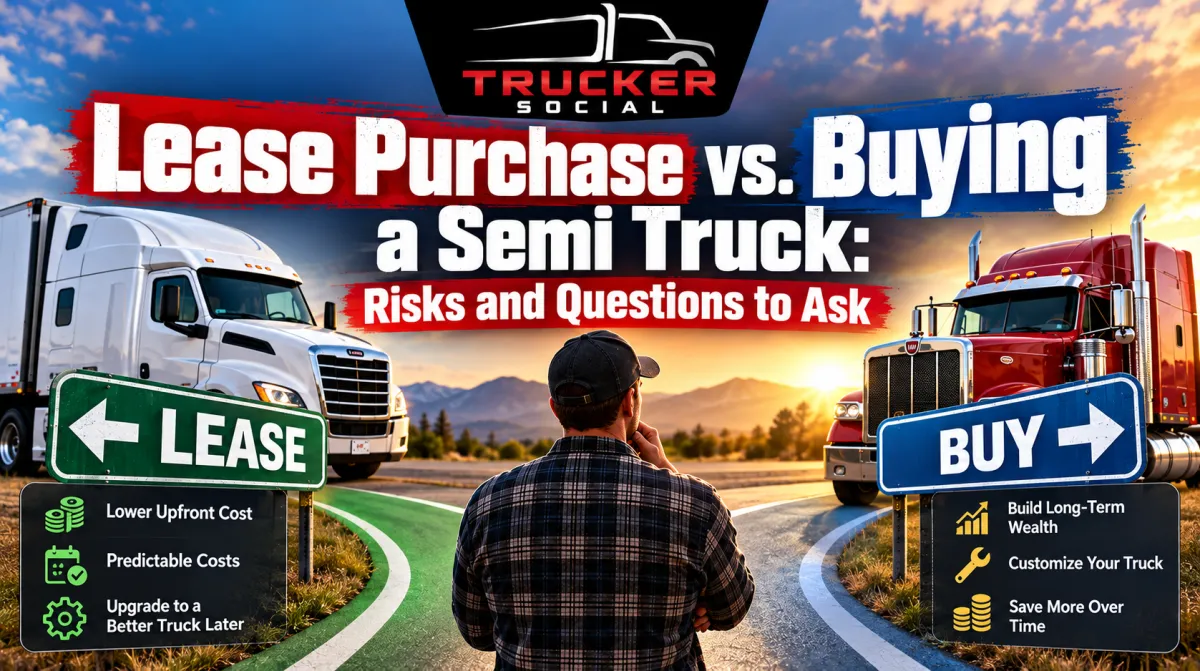
1. You want to spend less upfront
If weighing the benefits of lease purchase vs buying a semi truck, you may consider this option if you’d rather not tie up your cashflow. That cashflow is life-saving because 85% to 90% of new owner operators fail due to underestimating costs, according to AtoB. You may not have the money to make a big down payment on a semi-truck.
You may also have poor credit, which disqualifies you for many financing options. You can buy a semi truck with bad credit, but your options are more limited. For those with poor credit or not a lot of money put away, leasing will make it easier to become an owner-operator.
2. Can Upgrade to a Better Truck Later
Leasing lets you change to a better truck later at the end of your lease term. When you buy a truck, you will often feel stuck with it if something doesn’t work out. One of the nice things about leasing is that it continually gives you access to better semis with the latest technologies and amenities because you can often afford a better truck with a lease. For those unhappy with their truck, you can simply turn it in when the lease ends.
3. Predictable Costs
When leasing a semi truck, it gives you total cost certainty. As a business, unpredictable expenses are bad news. After you sign your lease, if you sign for a full service lease, it should cover your maintenance and repairs, meaning you can relax knowing a repair bill won’t hit you from out of nowhere. Doing this will also protect you during times of high inflation on truck parts and labor.
Related article: Owner Operator: Costs That Determine Your Profit
When Buying Makes the Most Sense…
1. You Slowly Own the Truck over Time
Every time you make a monthly payment on your truck, you own more of it. This will help you to build long-term wealth because at the end of the term, you will own the truck. This is known as owner’s equity, and this article is great for learning more about it. At the end of a lease, in contrast, you don’t own anything.
After you own the truck, you can use it as collateral to secure more loans. For example, you could use this route to expand your fleet, or you might use it to acquire real estate later. You can’t do that with a lease.
2. Personalize Your Truck
Buying a truck lets you customize it however you’d like because you own it. For example, many owner-operators, since they spend a lot of time on the road, will customize the rider seat and the sleeper berth for the maximum comfort. You can also install your own power unit to run climate control and electronics without needing to idle your engine.
There are no restrictions to customize your truck when you own it, but when you lease a truck, you can only customize it if those changes are reversible at the end of the lease. At the end of the lease, you need to be able to return it to its original factory condition.
3. You Want to Save More Money over the Long-Term
The biggest problem with leasing a truck as an owner operator is, without a question, over the long-term, you will pay more. That first investment of buying the truck might hurt more in the beginning, but it starts to even out toward the end as you save more money.
Risks of Leasing vs. Risks of Buying
The biggest risk of leasing is that you can sign with the wrong company and you will be stuck with a bad deal. You need to read your leasing contract carefully to ensure there’s nothing unfavorable in the contract. For example, you can choose lease purchase trucking jobs where you lease through a carrier, and you will own the truck at the end of the contract if you choose to. Usually, this involves paying a little more to buy it at the end.
There’s also the full-service lease and the net lease. It’s important to understand the difference. With a full-service lease, everything is covered under your lease. With a net lease, you’re responsible for all mechanical failures, tire replacement, and major upkeep.
What’s the biggest risk of buying a semi truck? The biggest risk is that you would buy a lemon. You could pour all that money into a semi truck only to find it needs repair after repair. This is especially true if you will be buying used. Another risk is that you could accept a high-interest subprime loan that sinks 18% to 22% of your cashflow into a truck.
You can buy without a down payment with some dealers, but this will leave you underwater on the asset. If you plan to buy a new semi truck, the risk is that it will have a steep depreciation rate. Most new semi trucks depreciate 20% to 30% of their value in the first year. That means on a $150,000 to $200,000 truck, you lose anywhere from $30,000 to $40,000.
Related article: How to Become an Owner Operator: A Practical Start-to-Finish Guide
Questions to Ask Yourself When Choosing to Lease or Buy a Truck
1. What kind of lease is it?
You want to know if it is a full-service lease or a net lease. You also want to know if it is a lease-to-purchase program or a traditional operating lease where you can’t buy the truck at the end even if you wanted to.
2. Will there be mileage caps or idle time on the lease?
Understandably, you want to make as much as possible on your semi truck, and if they put a mileage cap on your operation per year, this can drastically hurt how much you can earn. You also need to be aware of idle time because some leases will penalize high idle time.
3. What happens when the term ends?
At the end of the leasing term, you need to know how it will end. You want to know if you will be penalized for excessive wear and tear, or if there’s a maintenance reconciliation.
4. What does the loan structure and interest rate look like?
You want to know if the interest rate will be variable or fixed and how you plan to calculate it.
5. What are the taxes and down payment that I will need to pay?
Look for the exact down payment percentage you need to pay. You also need to look at the extra expenses like the Federal Excise Tax (FET) that you might owe.
Join the Owner Operator Discussion on Trucker Social
If you’ve read all this and still don’t know if you should lease or buy a truck, we would invite you to come visit us on our community platform at Trucker Social. You can sign up for your FREE profile and start communicating with other owner operators to see how they handled this important question when becoming an owner operator.