What Insurance Does an Owner-Operator Need?
Owner-operators face all sorts of dangers that can cost them serious cash. It can put their dreams of running a trucking business financially underwater. That’s why if you don’t carry the right insurance, you could be putting your business at risk. Everything you worked hard for could go up in green smoke with a single mishap without owner operator insurance.
Some of the risks you face as an owner-operator include cargo damage, accidents, commercial liability, and property damage. Those risks come as part of doing business in trucking. You can’t avoid them unless you never leave the parking lot with your semi-truck. That’s why insurance matters so much.
Keep reading because at Trucker Social, we’re going to highlight everything you need and why it makes sense to get it. As an owner-operator, you can expect to pay anywhere from $9,000 to $17,000 per year for insurance if you run with your own authority, but it will be worth it in the event of a mishap. As for owner operator insurance cost per month, it usually works out from $900 to $1,800+ per month.
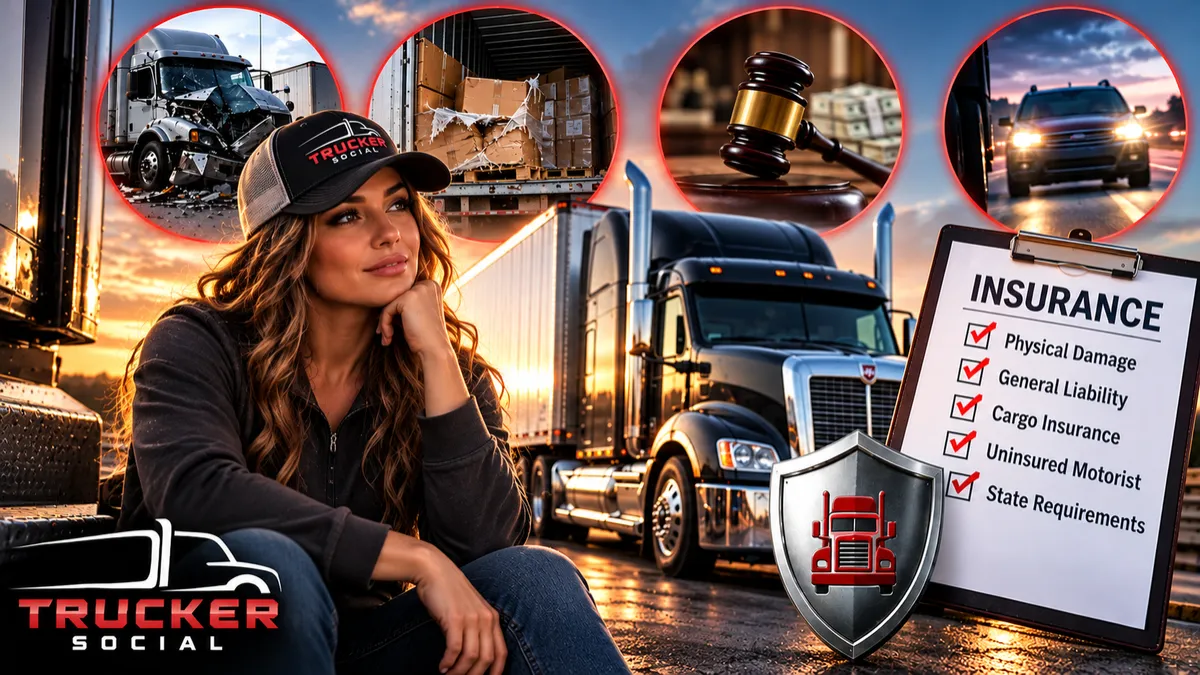
Physical Damage Insurance
As an owner-operator, physical damage insurance covers you regardless of who was at fault. If you damaged your truck or trailer from collision, theft, fire, or bad weather, you can use this insurance to get back up and running quickly.
Especially when your truck is your livelihood and you’ve got bills piling up, you can’t afford to let it sit while you wait to repair it. This insurance will help you to quickly get it back up and running.
Leased trucks and trucks on a loan will require this insurance. For those who own their truck outright, they may not require it, but you still may want it on your truck since it can cost a fortune to replace your trucking equipment.
General Liability Insurance
Semi-trucks account for 3% to 5% of all crashes on U.S. highways. While they may make up a fraction of highway crashes, they cause 10% to 12% of all fatal highway crashes. That’s because when you have an 80,000-pound semi barreling down on a 4,354-pound car, with all its force, it goes without saying, there are often fatalities in these types of crashes. Those crashes can lead to big claims of liability against you.
When you run a trucking business and you or one of your trucks get into an accident with another vehicle where there were serious injuries, general liability insurance covers you. Oftentimes, the other party will target your assets because you operate as a business. It will cover you for your medical expenses, legal fees, and even a settlement if they find that you can be held liable for the accident.
This is one of the owner operator insurance requirements. You cannot bypass general liability insurance. You need to hold at least $750,000 worth of coverage because the FMCSA requires it for general freight. If you run hazmat loads, they require you to have $1,000,000 in coverage.
Shippers and brokers also won’t work with you if you don’t carry it because they can be held liable. It covers you in the event of a lawsuit or claim.
Cargo Insurance
Before you can work with a broker, they often require you to carry $100,000 in cargo insurance at a minimum. If your cargo is destroyed by fire, water damage, collision, theft, or a loading or unloading accident during the transport of it, your owner operator insurance for trucking will cover you.
That matters now more than ever as cargo theft in trucking has steadily been on the rise with U.S. and Canadian losses hitting $725 million in 2025, a 60% increase, according to the FBI Philadelphia Field Office.
For electronics, refrigerated goods, or high-value goods, they may require you to carry more. Just check ahead of time because sometimes cargo insurance will have exclusions, and you want to see that it doesn’t exclude what you’re carrying at the time.
Related article: Fuel Cards for Owner-Operators: How to Compare Savings and Fees
Uninsured Motorist Coverage
Around 15.4% of all U.S. drivers carry no insurance or one-in-seven drivers. This also depends on the state like in Mississippi, it’s as high as 28.2% of all drivers, according to the Insurance Research Council. If you get into an accident and they have no insurance, you would have to cover the costs yourself.
Since you depend on your truck for a steady income, having to suddenly shell out money because the other driver didn’t have coverage could be a tough lesson if you don’t have this one.
Understand State-Specific Coverage
Every state has different coverage requirements, and when you cross state lines, you need to know what those differences are. For example, California demands a higher minimum than even the federal limit with $1 million being the baseline coverage. New York requires a higher cargo coverage for specific types of freight. Florida requires extra personal injury protection.
Related article: How Owner-Operators Find Consistent Freight
What Do You Think of Insurance for Owner-Operators?
We hope this clarifies owner operator insurance for truckers and what you need to have before you set out on the road. Understanding what it requires is essential to protect your business that you worked so hard to build. You can browse insurance providers, and we would recommend shopping around for insurance because you often get a better deal.
If you’d like to speak with other owner-operators, sign up for your FREE profile on Trucker Social. For those looking for qualified and experienced truckers, you can even hire drivers on our platform.