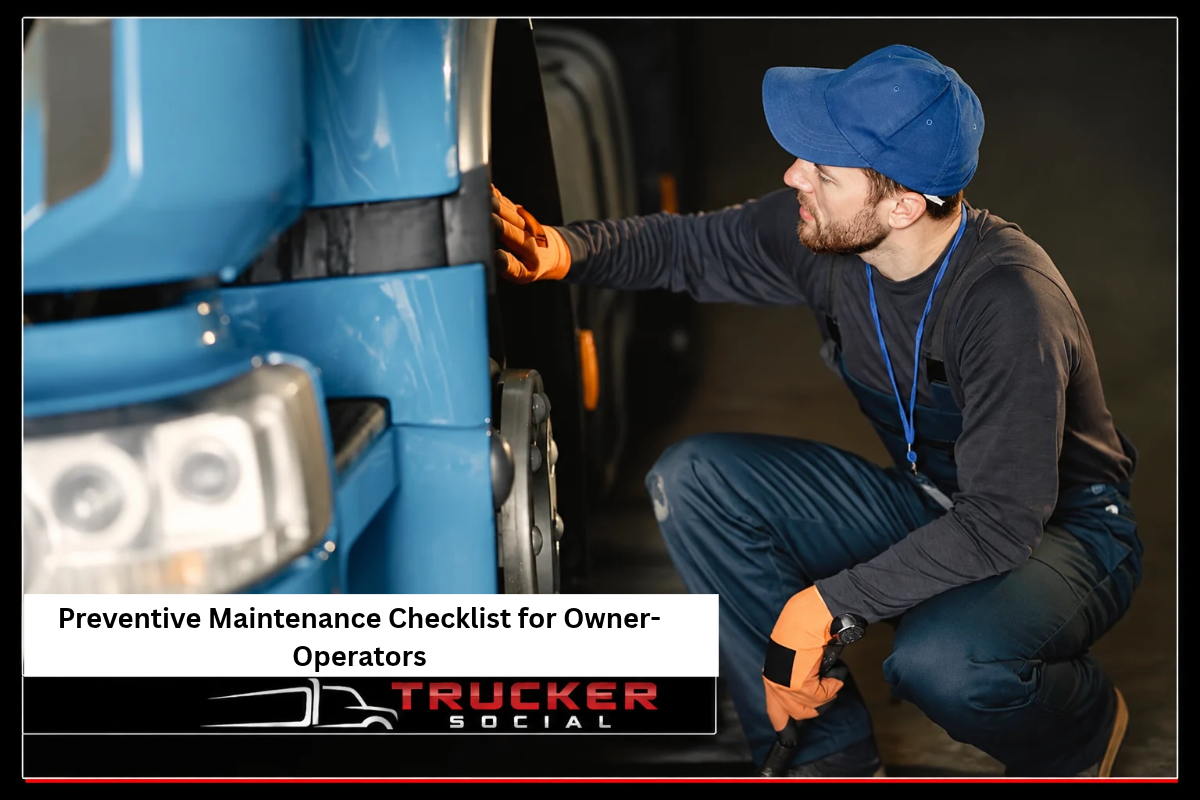
Preventive Maintenance Checklist for Owner-Operators
When you pay for routine owner operator truck maintenance, it costs a fraction of what you’d pay for a full-blown breakdown. Not only that, but a well-maintained truck maintains resale value, adding anywhere from $500 to $1,500+. This is because it transforms the unknown risk of the vehicle into something you can tangibly see.
Preventive maintenance may not sound like a great thing in the beginning when it costs you money to keep it up. However, you save significant cash over time because it catches problems before they can snowball into bigger issues.
To do it right, read your owner’s manual since they will tell you the exact schedule you should follow. For owner-operators with a warranty on their truck, following the scheduling in the owner’s manual will protect your warranty.
Best Practices for Preventive Maintenance
As an owner-operator, your paycheck depends on your truck running well. When you invest in owner operator truck maintenance, you lower the risk of unexpected downtime. You can keep your operations running more smoothly. Let’s take a look at the general best practices for maintaining your semi-trucks.
Keep to the scheduled maintenance: Check your owner’s manual, but you typically need to schedule preventive maintenance every 10,000 to 25,000 miles.
Perform pre-trip and post-trip inspections: Every day you want to walk around your semi-truck to inspect it for its tire pressure, brakes, lights, mirrors, fluid levels, and emergency gear. Doing this lowers the risk that you leave the yard with a hidden mechanical failure and drastically lowers the risk of emergency roadside stops.
Pull out a detailed checklist: Having a checklist ensures that you never overlook something of critical importance. You want to update your checklists regularly to keep up with its unique condition and requirements.
Regularly check your fluids: You need to actively monitor the fluids of your semi-truck. This includes the oil, coolant, transmission fluid, brake fluid, power steering fluid, and diesel exhaust fluid. Catching dirty fluid early can prevent a minor problem from turning into a full engine overhaul ($15,000 to $40,000) or replacement of a transmission ($8,000 to $15,000).
Inspect your tires: You should inspect your tires before every trip, during a mid-trip stop, and once a week, perform a deeper inspection of your tires.
Related article: How to Buy a Used Semi-Truck without Overpaying
How to Perform Maintenance Strategically
Every experienced owner-operator will tell you to perform your maintenance schedules with strategy. You want to minimize your downtime, but you especially want to lower the risk of disruption to your trucking business.
To begin, try to perform your semi-truck maintenance during slow periods. Look for a time with lower demand to keep the maintenance schedule from interfering too much with your business. Be sure to speak with your freight partners and clients ahead of time so that they know what’s happening.
You want to look for the most critical areas of your truck that demand your attention. For example, maybe the tread on your tires has started to go. You may want to replace that ahead of time to avoid long downtime.
Finally, tell your drivers to report minor problems early. Your drivers will be the best early-warning system on your truck because they’re around it all the time. Not to mention, no trucker wants to drive a truck that could cause an accident, killing someone, so semi truck maintenance is in their best interests.
How to Understand the A-B-C Service Intervals
Every maintenance scheduling has A-service, B-service, and C-service. You might think of them as each service interval as building upon the last one. For example, A-service maintenance sets the very foundation. You need to perform A-service every 15,000 to 20,000 miles.
A-service maintenance was meant to catch your basic wear-and-tear like engine and fluid services, brake system inspection, etc. B-service is done every 30,000 to 40,000 miles. This level of service is slightly more complex with the transmission being involved and differential services. C-service is performed every 60,000 to 75,000 miles, and this one will be your most comprehensive semi-truck preventive maintenance.
Keep Documentation of Your Preventive Maintenance
You want to keep documentation because it can help when you go to sell the truck, but it can also help the semi-truck technicians to predict and stop future problems. Keep the documentation of everything that you perform on your truck. This is about more than just meeting the minimum requirements of documentation on your truck. It will genuinely help you to do this. Thanks to modern software, it has become easier than ever before.
Related article: How to Become an Owner-Operator: A Practical Start-to-Finish Guide
Owner-Operator Truck Maintenance Checklist
The following list gives you a semi-truck maintenance checklist you can follow to keep up with maintenance, but we would highly advise you to follow what your owner’s manual says. We advise this because specific makes and models will require special maintenance that others might not.
Here’s what a basic truck maintenance checklist looks like:
Pre-trip and Post-trip Checklist
Performed? (mark with x yes) | Maintenance Check | What to Check |
|---|---|---|
Tires and wheels | Check tire pressure and look for bulges, cuts, and stuck debris. | |
Fluids | Examine the oil, power steering fluid, anti-freeze, and windshield washer fluids. | |
Brakes and air systems | Test your trailer brakes, parking brakes, and service brakes. Listen for leaks at the chambers, fittings, and lines. | |
Lights and electrical systems | Make sure that your brake lights, headlights, turn signals, taillights, and hazard flashers all work properly. | |
Cab controls | Check your mirrors, windshield wipers, truck horn, and active fault codes on the ELD. | |
Safety and coupling | Check that you have your fire extinguisher, your seatbelts work, reflective triangles, and the fifth wheel and the coupling devices are locked and secured. |
Weekly and Monthly Routine Checks
Performed? (mark with X if performed) | Maintenance Check | What to Check |
|---|---|---|
Terminals and batteries | Clean your connection and look at the terminals for corrosion. Do a load test if you believe you have a weak battery. | |
Hoses and belts | Look at your cooling hoses and drive belts. Inspect it for cracks, frays, or soft spots. | |
Brake linings and slack adjusters | Check to see that your slack adjusters are properly adjusted. Measure your brake lining thickness. | |
Frame and Suspension | Examine your leaf springs, your hangers, and U-bolts. Look at your frame rails for corrosion, shifts, and cracks. | |
Fuel and air filters | Look at your air filter restriction indicator. Drain the water and sediment from your fuel-water separator. In general, replace your fuel and air filters every month. |
Mileage & Service Intervals
Performed? (mark with X if performed) | Miles | What to Do |
10,000 to 25,000 miles | Rotate the tires, inspect the air and fuel filters, and change the oil and filter. | |
100,000 to 150,000 miles | Replace the air dryer cartridges. | |
250,000 to 400,000 miles | Clean or service the Diesel Particulate Filter (DPF). | |
500,000 miles | Change your filters and transmission fluid. | |
750,000 miles | Flush and replace the engine coolant. |
What are Your Thoughts?
We hope this was genuinely helpful for owner operator truck maintenance. Keeping your truck well-maintained ensures that it will continue to run properly. At the same time, it will save you a lot of money because you typically will avoid some of the more costly repairs. Not to mention, with planned maintenance, you can plan for it to minimize your downtime. You can keep your trucks running when it matters most.
If you’d like to find maintenance providers and parts, we would invite you to join Trucker Social. We have a marketplace where you can find different services and affordable truck parts that can keep your operations running.