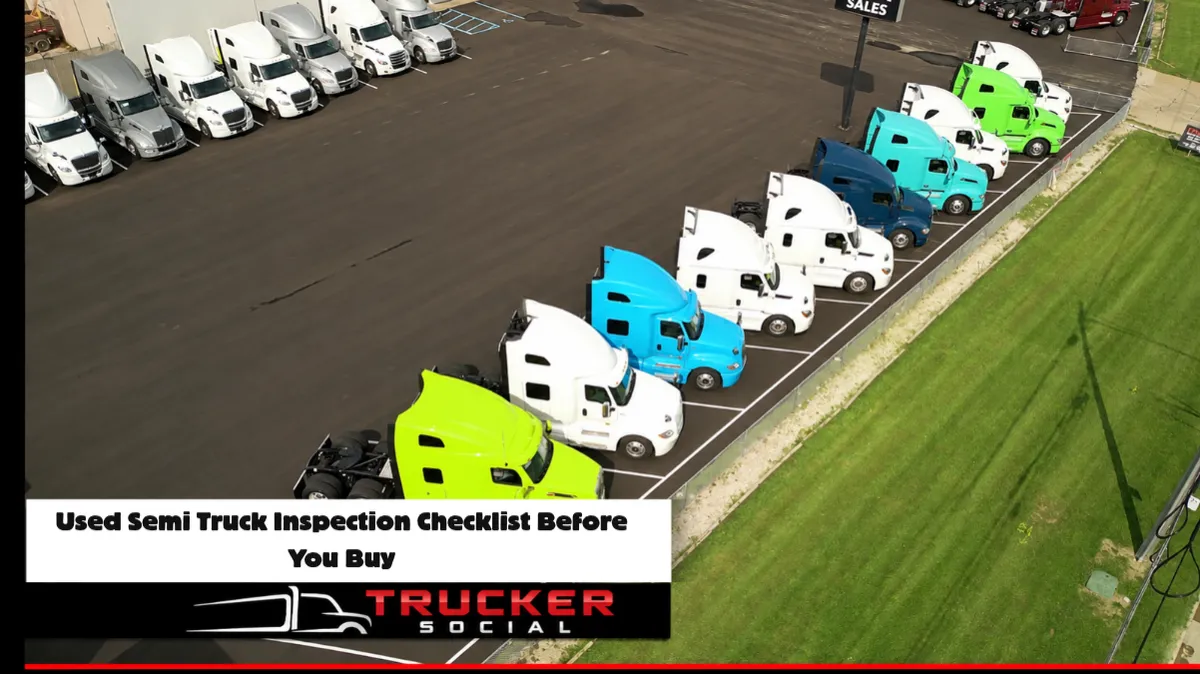
Used Semi Truck Inspection Checklist Before You Buy
Never let a nice paint job fool you with used semi trucks. You can do well with used trucks, but you need to do your research beforehand. Conduct a thorough inspection of the engine, transmission, chassis, suspension, tires, brakes, cab, electrical system, and documentation.
Our used semi truck inspection checklist will help you to roll through a dependable checklist when buying to ensure that you don’t waste money on a lemon. Many owner-operators choose to buy used because of it being a more strategic and cost-effective choice to buying new. Let’s take a look at how to inspect a used semi truck before buying it.
Exterior and Frame
On a day with good daylight, circle the semi-truck and inspect every square inch of the exterior. You want to start with the front and work your way around in a circle. This guarantees that you skip nothing when you go to inspect it.
Here’s what you’ll be looking for:
Neglected maintenance
Structural damage
Uneven wear
You can expect some surface wear on a used truck, so don’t worry too much about that. What you want to look for is damage that goes deeper than the surface.
When you conduct an inspection of the exterior, examine the hood, lights, bumper, mirrors, sleeper panels, roof fairings, loose hardware, signs of collision repair damage, and missing parts. Fresh coating in a single area could indicate damage from a previous wreck that they repaired.
While collision damage shouldn’t automatically disqualify it, you should ask for documentation and ask more questions.
Look at the fifth-wheel because it needs to be in good working condition if it will pull trailers safely.
Engine: What to Inspect
Beware of this trick some dealers use where they automatically start the vehicle for you. Don’t let that pass on your checklist for truck inspection. You need to look out for yourself. Sometimes, they do this for legitimate reasons. However, a cold start gives you valuable information about the condition of your engine.
You can tell the idle quality, smoke, fluid pressure, and cranking
When you pop the hood of your engine, examine it for leaks in the following areas:
Fuel system
Front cover
Valve cover
Turbocharger
Charge-air cooler
Hoses
Radiator
Engine
After you look for leaks, check the hoses for residue from dried coolant, swelled hoses, or rubbed hoses. Check the condition of the oil and coolant, but don’t take this as an automatic sign of good engine health since they may have recently put in clean oil.
You especially want to look for electrical problems since they can be incredibly time-consuming. Check for loose wiring, corrosion in the fuse areas, or improvised repairs. Look at the wiring harnesses, battery terminals, and alternator connections.
Transmission
When you look at the transmission, check to see how smoothly it downshifts and upshifts. Also, look at the physical fluid condition. It should be pink or cherry red and have the smell of faint petroleum. If, on the other hand, it smells burnt or sharp, it could indicate that the transmission overheated.
Check the drain plug to see that it doesn’t have flakes, metal chips, or missing teeth.
Related article: Owner-Operator Startup Costs: What to Budget Before You Buy a Truck
Chassis and Suspension
When inspecting a used semi truck, you want to look at the chassis for cracks and fractures on the main rails, the gussets, and the crossmembers. Especially check the fifth-wheel attachments, high-load zones, and suspension mounts.
Now with a used semi-truck, you will always have some wear and tear. However, when you have a deep structural issue, the FMCSA can place your truck out-of-service. Look for rust. There’s a difference between surface-level rust and deep structural rust that hurts the infrastructure. Beware of pits or frames rusted all the way through.
If they previously overloaded the truck, you can often tell by the damage to the chassis and suspension. Look for cracked mounts or sagging. Also look for repeated repair welds, such as recurring fractures, overlapping beads, and heat-affected distortion. This shows you that they worked the truck beyond its rated capacity, and you don’t want to buy that kind of used semi-truck.
Brakes and Tires
When inspecting an air-brake system, check it for leaks that you can hear. You also want to look at the drum condition and the pad wear. You want even brake pad wear and ask for recent DOT inspection records. When you perform this inspection, you want all the components to be cold because it gives you the best idea about it.
Look at the tires as well because this tells you how well they kept everything else up. Check the tread depth for each tire. Look at the tires even in the harder to see areas. Semi-trucks run on 18 wheels and uneven wear can cause issues with your suspension, alignment, brake drag, and overloaded axles.
Related article: How to Buy a Used Semi Truck Without Overpaying
Documentation, Electrics, Cab, and Sleeper
You want to ask for the full-service history of the vehicle. Checking this is essential because it tells you how well they maintained their semi-truck. Looking at the mileage by itself tells you something, but you get the full picture with the service history report.
When you inspect the chassis and the engine numbers, always check to see that they match the registration documents all the way. If they don’t match, it’s a huge red flag. It means that there are serious legal, administrative, or safety hurdles.
You also want to look at the windshield wipers, the doors, the roof, and the sleeper seams. Lift the floor mats and check for corrosion, mildew, damp carpet, or patched areas. This matters because if you have water damage, it can hurt your electrical system and cause you ongoing issues with your cab.
When it comes to the sleeper, check it for interior lighting, auxiliary and inverter electric equipment, and storage compartments. Check to see how comfortable the sleeper area is. All of these details will have an impact on how comfortable you feel in the truck. Since you spend a lot of time on the road, you want to sleep comfortably.
What are Your Thoughts?
We hope this guide with a used semi truck inspection checklist helps you to buy your next used semi-truck as smartly as possible. It does take time to conduct a thorough inspection, but it’s worth the effort to ensure that you have a good truck to support you in your work. Some people also choose to hire an unbiased professional semi-truck mechanic to conduct the inspection and report back the results.
To find inspections and equipment listings, we would invite you to come check us out on Trucker Social. We’re a trucking community, so you can find exactly what you want without the irrelevant listings.