Owner-Operator Startup Costs: What to Budget Before You Buy a Truck
Before you ever start your trucking business, you need to understand your owner operator startup costs. You must understand the bills you need to cover to improve your chances of success. When I first started as an owner-operator, I wish someone had told me these things because it would’ve helped me to get off to a good start.
Smart decisions are essential to your success, and you want to stay on top of expenses to stay ahead of the game. Read this article to find out what you need to budget for owner operator expenses before you even buy a truck. Becoming an owner-operator is more than just the truck. An owner-operator faces high risk, but if they do it right, they also have high reward.
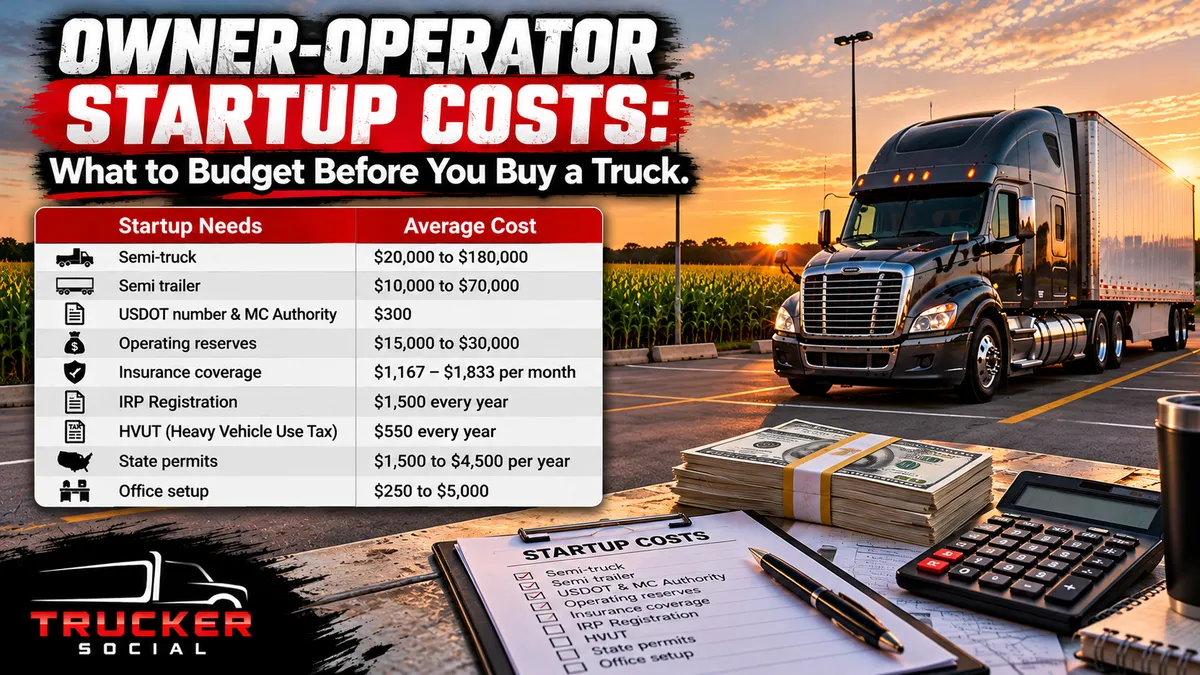
Owner-Operator Startup Costs
We want you to understand your owner operator cost right from the start. You’ll know what you’re getting into, and that’ll make you a lot happier in the end. Let’s break down the costs.
Startup Needs | Average Cost |
Semi-truck | $20,000 to $180,000 |
Semi trailer | $10,000 to $70,000 |
USDOT number & MC Authority | $300 |
Operating reserves | $15,000 to $30,000 |
Insurance coverage | $1,167–$1,833 per month |
IRP Registration | $1,500 every year |
HVUT (Heavy Vehicle Use Tax) | $550 every year |
State permits | $1,500 to $4,500 per year |
Office setup | $250 to $5,000 |
Startup Costs: Depend on Your Choices
You can’t avoid the owner operator startup cost mentioned, but how much you pay depends on you. For example, you can buy a new or a used semi-truck. A used semi-truck will cost you less, and it will also tend to lower your insurance rates, but some prefer to start with a new truck because they will face fewer costly repairs. Semi-truck repairs can get expensive fast.
The same goes for a semi-truck trailer, or your office setup for your business. You can choose how expensive you want it to get, and you can start cheaper and go bigger as your business prospers.
In the beginning, especially if you don’t have a lot of money, you may want to start out smaller so that your operating costs will make it easier to succeed. You can slowly expand as your trucking business prospers. Let’s take a closer look at the costs.
Related article: How to Become an Owner-Operator: A Practical Start-to-Finish Guide
USDOT Number & MC Authority
Your USDOT number costs nothing to file, but you still need it, which is why we mention it with the MC authority. It costs $300 to file the MC authority. Luckily, this is a one-time fee. You must submit your filing fee with the application.
Operating Reserves
Your operating reserves will especially cover you during the slow season with freight. Having an operating reserve ensures that if something bad happens in the first 60 to 90 days, you can survive it. The operating reserves ensure that you can keep your doors open regardless to keep earning money. It was made to cover your insurance, truck payments, and out-of-pocket truck maintenance.
Insurance Coverage
Expect to pay anywhere from $1,167 to $1,833 per month for insurance with owner operators paying between $9,000 and $17,000 per year, according to AtoB. This depends on your truck and how much experience you have as an owner-operator. New owner-operators generally pay more for insurance. If you get a traffic violation, this can add to your insurance. Another thing to know is even if one of your drivers get a traffic violation, it can add to your insurance costs.
IRP Registration & HVUT
You need to buy IRP registration when you travel multiple states or you drive into the 10 provinces in Canada. You don’t need this if you will drive into Mexico because Mexico isn’t a member of the IRP system. With HVUT, also known as the heavy vehicle use tax, you will need to pay this if you operate on public highways and have a weight of over 55,000 pounds.
Here’s how HVUT works:
55,000 to 75,000 lbs: $100 plus $22 for each additional 1,000 pounds over 55,000 lbs.
Over 75,000 lbs: Capped at a maximum of $550 per year.
State Permits
How much you pay for state permits largely varies from one state to the next. You need to look up what’s required for your individual state. Some states will require unique things, so you need to know the requirements of your state. To give a brief overview (but look into this for yourself), let’s take a look at a couple of them:
New York: Owner-operators from this state need to pay the New York States Highway Use permit tax, and they need the decal.
Kentucky: This state requires a weight-distance tax permit.
New Mexico: For the state of New Mexico, you need to pay a weight distance tax electronic permit.
Oregon: The state of Oregon has a weight distance tax and a bond that you need to pay. Important to note, you must always keep the physical paper copy of it in your truck.
Just a quick disclaimer, this is by no means a comprehensive list of the permits you need. Things like this can change overnight, so you need to look into it for yourself. There may be other requirements, and while some states weren’t mentioned, that doesn’t mean they don’t have permits you need to pay for.
Related article: Owner-Operator Pay: Gross Revenue vs Take-Home Pay
Master Your Cashflow
When 70% to 80% of owner-operators fail, poor cashflow is going to be your biggest culprit. This is the one owner-operators overlook the most. It causes them the most problem.
Right from the beginning, you need to set out with the goal of becoming a master of cashflow. You can have a business that’s profitable on paper, but if you run out of cash to cover your daily costs, you could still find yourself at the attorney’s office filing for Chapter 7 Bankruptcy.
One of the biggest challenges in trucking is that major expenses can come due right away and without warning. If you don’t have a way to cover it, you will be gulping water and begging for air, even if you're profitable.
Meanwhile, shippers and brokers might have an extended payment term of between 30 days to 90 days. You don’t want to be forced into high-interest debt because it can trigger a downward spiral that means the beginning of the end for your trucking business.
Trucker Social Helps Owner Operators to Understand Their Startup Costs
Having a strong foundation for success is built on knowing the owner operator startup costs. Trucker Social is a community of truckers, and if you’re a new owner-operator, you can receive guidance that will help you to succeed. You can network with others in this community and see how they handle the challenges of running a trucking business.
To get started, all you have to do is go to Trucker Social and explore trucking business resources.