What Does CPM Pay Mean for Truck Drivers?
When you do OTR trucking, you'll most likely get CPM pay. It’s common for OTR, but even getting regional CPM pay for truck drivers is fairly common. Usually, with regional, because you run fewer miles, they will pair your trucking with accessorial pay. If you don’t know what any of this means, keep reading because we’re going to explore what CPM means, and we’re going to look at what issues can arise if you only focus on the cents per mile.
Referring to CPM, we’re talking about a common payment structure that truckers encounter. In fact, when it comes to trucking for OTR and regional, it’s one of the most common payment structures you’ll encounter. When you run locally, the most common is hourly, but we’re going to cover CPM in depth and briefly look at its difference from percentage pay.
What Does CPM Pay Mean for Truck Drivers?
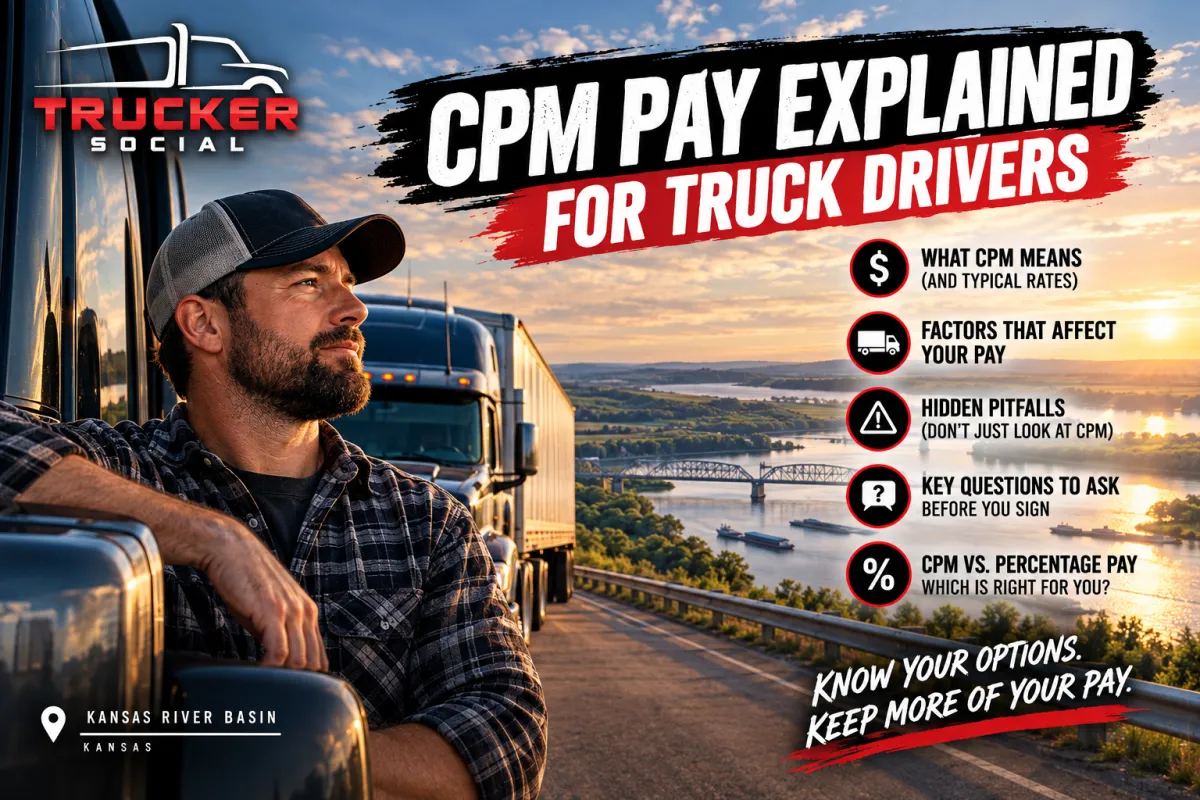
What is CPM in trucking? CPM stands for cents-per-mile, and it means that you receive a certain amount of cents for every mile that you run. What is the average CPM for truck drivers? If you’re new to trucking, your most common CPM for truck drivers will range anywhere from $0.45 to $0.55 per mile.
Now, you have a few key factors that will impact the CPM. First, the type of freight you run will have an impact on the CPM. For dry van positions, you can expect anywhere from $0.45 to $0.50 per mile. Meanwhile, if you run flatbed or specialized refrigerated (reefer), you get a slightly higher CPM from $0.50 to $0.60 per mile.
Now, the CPM might be higher, but reefer also means you spend more time at the loading docks, so you don’t want to focus exclusively on CPM.
Don’t Be Misled by a High CPM
If the company fails to provide you with consistent miles every week, your CPM will not tell you much about your paycheck. In many cases, you might see a lower paycheck than someone with a lower CPM who runs the miles consistently.
You also want to look out for other forms of payment because this will make your paycheck better. For example, you want to look out for things like detention pay and layover pay. Detention pay is when a carrier has you waiting for an extended period of time at a shipper or receiving facility. Typically, detention pay ranges anywhere from $25 per hour to $100 per hour, with $50 per hour being the most common. Not all companies will offer this, however.
Layover pay is when you need to sit idle and wait overnight or for a long time. The average ranges from $100 per day to $250 per day. Sometimes you need to claim it in a certain way to receive this pay.
Now, we mention this because it will all tie in with your CPM pay and help you to get a better paycheck.
Related article: How to Read a Truck Driver Pay Package
Cents-Per-Mile: The Full Picture
In 2025, the US Bureau of Labor Statistics reported the average trucker pay from doing this was $58,640. This depends on your experience, your endorsements, and the trucking company. The most experienced drivers receive anywhere from $0.65 to $0.85 per mile. With this system, company drivers will receive a fixed amount of cash regardless of the load payment.
The problem with this system, despite it being the most common, is that your payment will vary based on how many miles you get that week. If you’re at entry-level, your pay on a slow week can drop from $400 to $800 that week. It can be due to slow miles caused by waiting at the docks, or simply not getting consistent miles.
Many carriers like this system because of its simplicity. Whether you’re moving steel, lumber, machinery, or construction materials, the pay stays the same, making it easy to calculate. From load to load, you’ll be able to see how to generate the most income.
Related article: Truck Driver Jobs: How to Compare Pay, Home Time, and Benefits
Questions to Ask Before You Agree to a Job
Because the CPM can be misleading, you have a few questions you need to ask before agreeing to the job. Let’s take a look at the most common:
How many miles do your drivers average each week?
You want to get this in writing, but you need to ask them what the average week looks like for drivers. You might also request to speak with other drivers of that company to see what they average. Especially focus on what experienced drivers average, rather than the top earners, since that can mislead you.
How long are the hauls?
You want to ask this because the length of the hauls will explain how much you’ll transition, how often you’ll load and unload, and what the normal work week would look like.
How frequently do you get stuck in between loads and waiting?
This can directly impact your cents per mile, so you want to pay close attention to it. Every operation has delays, but what distinguishes trucking companies is how often they happen and how quickly they can get you repositioned to keep going.
Percentage Pay vs. CPM Pay for Truck Drivers
Which model you should choose depends less on superiority, but you may find that one fits you better. There are many experienced drivers who literally leave the percentage pay because they prefer visible income. They don’t have to worry as much about freight rate fluctuations, which can cut into your paycheck when you go after percentage pay.
Percentage pay is where you receive a certain percentage for the delivery of the freight. Normally, the company driver receives anywhere from 25% to 35% of the gross revenue from each trailer. You’ll commonly encounter this with flatbed, specialized, and chemical tankers.
CPM is a better choice for those who want predictable earnings. You can more easily forecast how much you’ll earn for that week.
Trucker Social Can Help You to Compare Job Compensation Structures
At Trucker Social, we’re experienced truckers with years behind us. With that in mind, we can help you figure out what job compensation structure would work best for you. Looking at CPM by itself without understanding the full story behind it can be dangerous to how much you walk home with in take-home pay. You need to understand the full payment package to know what you’ll receive.
If you enjoyed this article and would like to get more valuable trucking content to help you advance in your career and make more money, sign up for a FREE profile at Trucker Social.