Owner-Operator Pay: Gross Revenue vs Take-Home Pay
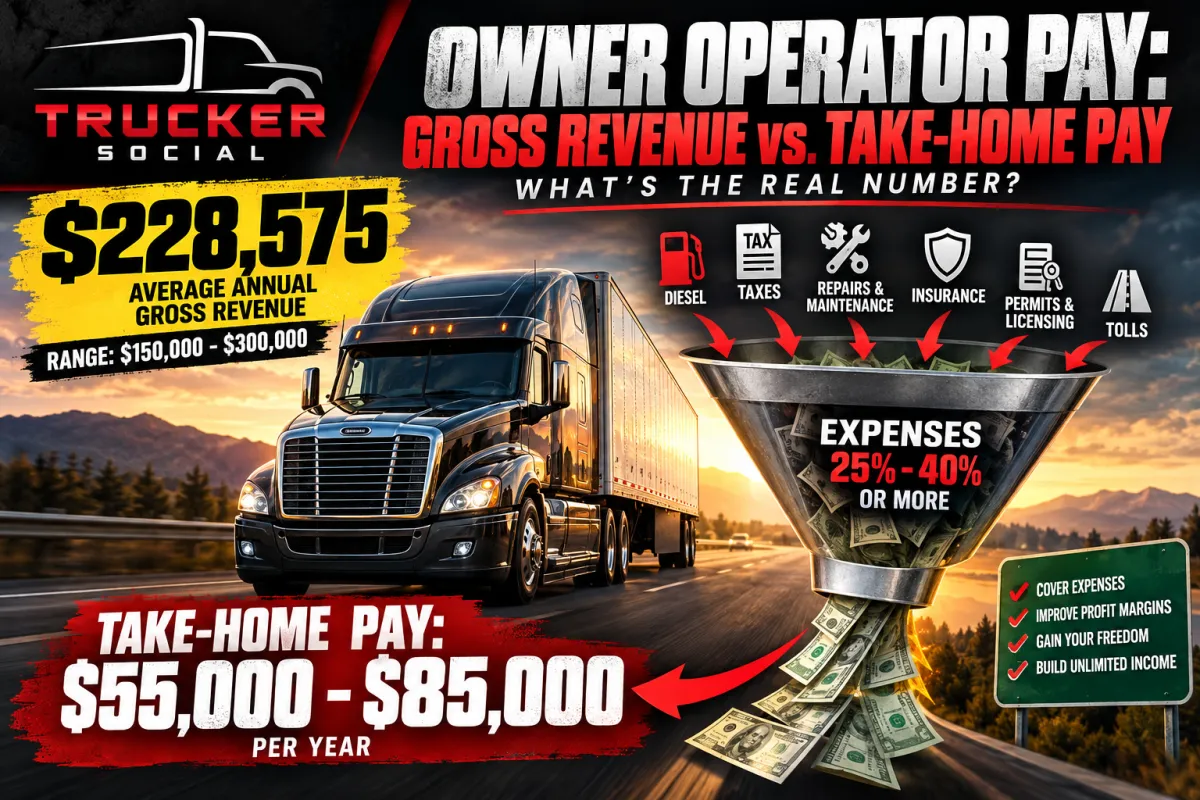
Many truckers will hear how owner operators earn around $228,575 per year, and they will think: Why would anyone want to be a company driver? Not so fast though because owner operator pay can be misleading. What you see there is the gross revenue and there’s a big difference between that and take-home pay or owner operator pay after expenses.
When you drive as an owner operator, your net profit margin will range anywhere from 8% to 15% of the gross revenue. While the top-performers can push their profit margins to 20% to 30%, most owner operators will fall in the range first mentioned. Along with that number, you can even fall below 8% profit margins, making it hard to survive.
Our guide here will put gross revenue and take-home pay into perspective. We’ll look at how this would compare to company drivers and the expenses you face as an owner operator.
Gross Annual Revenue of an Owner Operator
When we say owner operators earn around $228,575, we mean that as the average owner operator pay per year or gross revenue. In truth, you could range anywhere from $150,000 to $300,000. How much you earn depends on your freight type and your operating structure.
Typically, when an owner operator earns $250,000, they will be running an average of 120,000 miles per year.
Related article: How to Become an Owner-Operator: A Practical Start-to-Finish Guide
Take-Home Pay of an Owner Operator
Your actual take-home pay in most cases will look similar to a company driver. You can range anywhere from $55,000 to $85,000 per year. Heavy operational costs and the self-employment tax will drastically lower your take-home pay.
A lot of how much you take home in profit hinges upon how you structure it. You can structure it in many different ways. Your first year out will be the hardest because you need to learn to optimize your expenses to raise your profits.
After the third year, you will start to stabilize your cost base and pull your net into more of an average for owner operator CDL salary.
Gross Revenue vs. Take-Home Pay: What’s the Difference?
Gross revenue is your total earnings, but it means nothing because you will lose a portion of that to expenses like taxes, insurance, diesel costs, maintenance, and company driver pay. Expenses influence how much you take home, so you want to lower your expenses whenever possible.
Think of it this way: The gross revenue is what you see before it passes through the sifter. You will need to pass it through this expense sifter before you can see your total. The take-home pay is the finished product. That’s what you get to actually keep.
Why Would Someone Choose Owner Operator if the Pay is the Same as Company Driver?
An owner operator can make more or less than a company driver, depending on how they structure it. One reason people choose to be an owner operator is because you have no ceiling to your earnings. You can earn as much as you’d like by hiring company drivers to increase your income.
Let's say you're a company driver instead. As a company driver, you will hit a point where you can’t earn any more than that. Even the best company driver job will have a ceiling.
Owner operators can hire other drivers to keep raising their yearly income. Another reason is that even if they make the same as a company driver, they have their freedom. Company drivers depend on the company to tell them what to do and when to do it. They don’t have the same freedom to come home when they want.
Expenses: What Hurts Your Take-Home Pay?
Let’s take a look at the most common expenses and how it will impact your take-home pay. We will also examine quick ways to lower each one.
1. Diesel
The biggest expense that will impact owner operator pay is diesel prices. Owner-operators will pay anywhere from 25% to 35% of their gross annual revenue to diesel. Worse, how much you pay depends on the current prices of fuel. In a high-cost market, diesel can take as much as 35% to 40% of your gross annual revenue. Fuel cards are one of the best ways to lower your cost of diesel.
2. Taxes
When you run your truck as an owner operator, you will need to pay quarterly taxes. Taxes will take 25% to 30% of your income. How much you pay will depend on your deductions, your income, and the tax laws of your state. Some states like Texas, Washington, South Dakota, Alaska, Florida, and New Hampshire have no state income tax.
3. Repairs and Maintenance
This one can hit you by surprise, so you always want to keep money on stand-by to handle surprise repairs. For example, an engine overhaul can run you anywhere from $10,000 to $30,000. You also need to consider maintenance like tires, oil changes, and routine inspections. This one can be unpredictable.
4. Insurance Costs
Expect to pay anywhere from $12,000 to $20,000 per year for insurance. This is one of your biggest fixed costs, but luckily, you can predict what it will run. You will need things like cargo insurance, damage insurance, and primary liability insurance. The insurance cost will also depend on the type of freight you haul and the value of your truck. To lower your cost, you might drive a used truck, or keep your driving record spotless. You can also lower your insurance by installing safety technology.
Related article: Lease Purchase vs. Buying a Semi-Truck: Risks and Questions to Ask
5. Permits & Licensing
Running a semi, you will need to pay for different types of permits and licensing. An example of this is the state-specific permits of paying for your MC authority number, which has a filing fee of $300. You can normally expect to pay anywhere from $1,500 to $3,000 per year for permits and licensing. You can’t lower this one, and in some cases, you may lose money by trying to avoid licensing or a permit. You have to know when to pay as an owner operator and when to save because sometimes you make more money when you pay extra.
6. Tolls
This one varies dramatically, ranging from $2,100 to $8,000 every year. Some lease agreements will either totally or partially cover your toll fees. You can also use electronic tolling systems like E-ZPass or PrePass to sometimes save thousands every year.
Compare Opportunities and Resources at Trucker Social
Hopefully, this made it clear on the difference between gross revenue and take-home pay.
One of the great things about our platform being built for truckers is that you can find specialized resources. An example is our special marketplace for truckers. No more sifting through unrelated listings. Everything relates to trucking in some way, making it easier to find what you need or sell something to a market hot for what you have.
On our platform, you can also get career-advancing advice from experienced owner operators to see how they handle their gross revenue to get the best take-home pay. Truckers who want to become an owner operator may want to check into signing up for a FREE profile at Trucker Social.