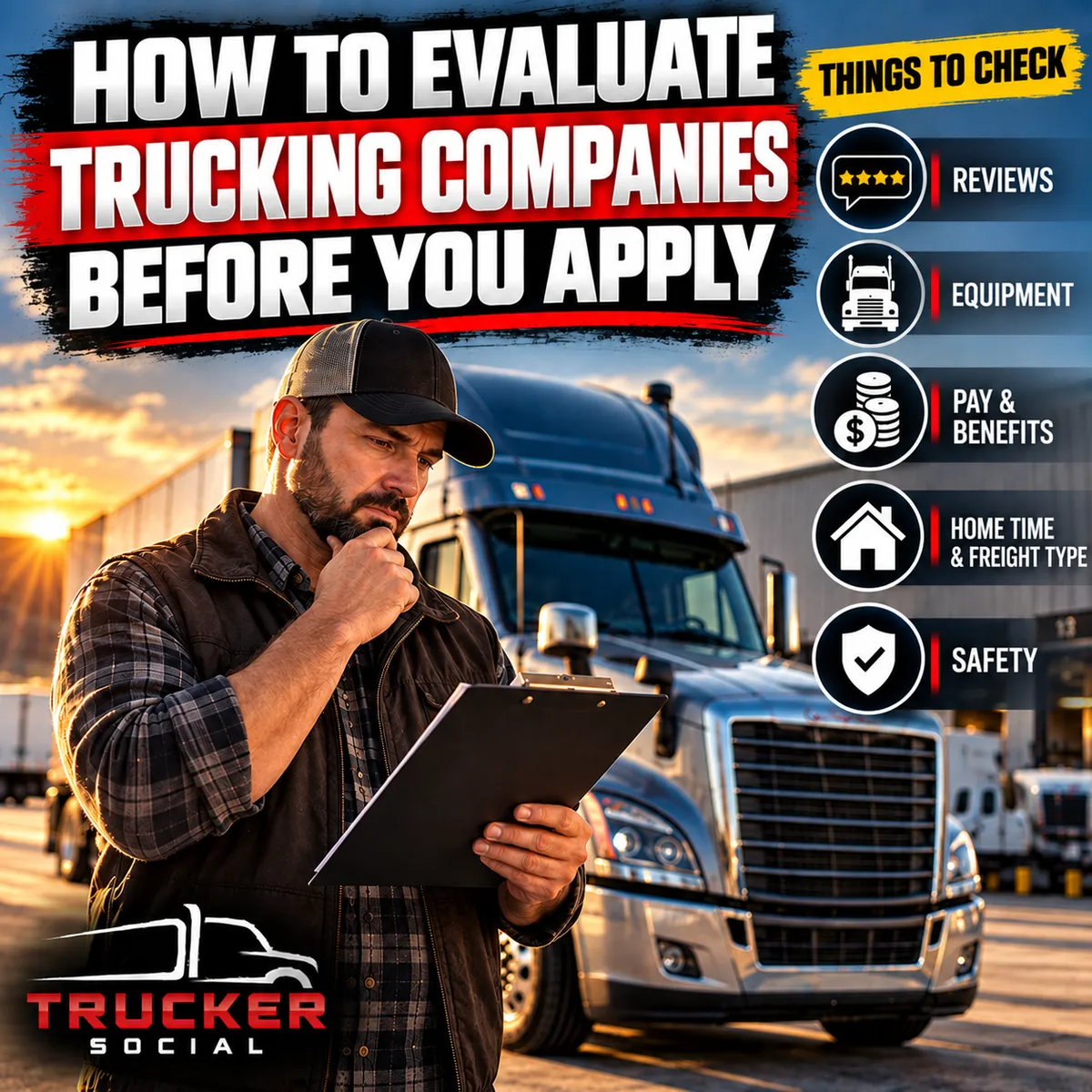
How to Evaluate Trucking Companies Before You Apply
You don’t want to hate your job. Spending hours waiting at a loading dock, being away for weeks at a time, and dealing with disrespectful dispatchers, when you get the wrong trucking job, your stress levels will shoot through the roof. Choose the right trucking company from the beginning, and you’ll have a much better experience.
Read trucking company reviews to check what kind of company you will be driving for. We’re going to look at how you can evaluate trucking companies before you even apply. When you work for the wrong company, there are even stories about companies stranding drivers in another state. It’s so important to do your due diligence beforehand to make sure you work for a reputable company.
We’re going to look at how you can evaluate trucking companies before you even apply. This will save you from wasting time on applications for bad companies.
Look at the Reviews, but Go Deeper
Read the trucking company reviews by drivers to get an idea of how the company treats its drivers. This is good. However, dive even deeper than the reviews. Ask drivers who worked for that company how they felt and how long they worked for them. How do I look up a trucking company? A simple Google search is the best way to find this information.
If the trucking company treats them badly, truckers will almost always willingly give you their honest opinion of that company. Trust me.
When a trucking company wrongs a driver, truckers want to talk about it. Look for that gossip. To be fair, every trucking company will have a driver with a bad experience, and it can be unfair to base your opinion on one driver. Opinions vary. Ask more than one driver. What you want to look for is common threads with truck company ratings.
When you have 10 drivers, and 7 out of the 10 reported having a bad experience with that company, take that feedback seriously.
Dispatch: Makes or Breaks a Trucking Job
Many trucking companies structure dispatch around truck utilization. For the driver, this comes at your expense. Communication in this environment becomes transactional, rather than collaborative. Disrespect from dispatch comes in the form of:
Unrealistic expectations
Dismissal of HOS regulations
Abusive or unprofessional tone
Lying about pay and loads
Sending drivers to empty yards
Failure to check if freight is ready
Better dispatch is more like partnership, and saying no won’t put a target on your back. Good dispatch will respect your input.
You can spot bad dispatch by asking targeted questions. For example, ask the dispatcher-to-driver ratio. More than 10 or 12 trucks per dispatcher, and you can bet they won’t answer your calls or solve your roadside issues. Look for dispatch with anywhere from 5 to 8 trucks.
Ask how they handle night and weekend dispatch. If they don’t have a separate night dispatch team, it means the dispatchers will take turns forwarding calls to their cell phones. This almost always leads to angry dispatchers who will ignore your call when you have a flat tire at 2 AM.
Also, ask if the dispatchers have actual behind-the-wheel experience. Dispatchers with no experience behind the wheel will set unrealistic expectations and have no true understanding of what they’re telling you. They also often won’t respect HOS boundaries, parking shortages, or weather delays.
Evaluate the Equipment in the Truck
The trucker lifestyle demands you spend days at a time in your truck, especially OTR or regional truck driving. Ask for the type of trucks they use and how old they are.
Bad equipment can ruin the experience and make driving less comfortable or even dangerous. For example, the air leaks might be so bad that you can’t hold your service pedal down for more than 30 seconds. Bad equipment makes more work on the job.
What Freight Type will You Drive? What Style of Driving?
After you drive truck for a while, you will start to find a niche you prefer. In the beginning, try out all the freight types to explore your options. Trucking companies may largely haul a specific kind of freight. You will find that every freight type will offer its advantages and disadvantages.
You need to consider if you prefer OTR, regional, or local. Each one has its advantages made for different types of truckers. These jobs can greatly differ. You want to see that the company meets your lifestyle preferences. For example, some truckers love OTR because of it having the best money, but for someone else like a married man with kids, they hate it because they spend weeks on the road and get no home time.
Regional is the happy middle ground where you might get home once a week, and you’re paid better than local, but worse than OTR. Local, you’re home every night, but the pay is the least, and it involves the most manual labor.
What Does Your Pay Package Look Like?
We already wrote an awesome article on how to evaluate your pay package. If you want an in-depth look, check it out here. To sum up how to evaluate a pay package, you need to look at the whole picture. Never let a trucking company tell you only about the cents-per-mile (CPM) pay.
The CPM pay can be very misleading by itself. Ask for how many miles you run per week. You often get the best information by asking a couple of truckers, rather than the recruiter.
Besides the CPM, ask for the following:
Detention pay
Layover pay
Home time
Per diem structure
How to Spot How Seriously the Company Takes Safety
Truck driving ranks 7th for the deadliest occupations in the United States. Some companies won’t take your safety as seriously as you do.
I’ve known drivers who had to threaten to quit because the company refused to fix the brakes.
The problem is, you may struggle to figure out how seriously a company takes safety until it’s too late.
You can use this simple trick to see how seriously they’ll take your safety. Look at how long the orientation is for both experienced and inexperienced drivers.
For experienced drivers, orientation should last 1 day, and for inexperienced drivers, it should last anywhere from 3 to 4 days and have a well-structured program that covers:
Pre-arrival vetting and paperwork
Safety and regulatory training
Technology equipment walkthrough
Culture, compensation, and management
The orientation should also be paid. Also, ask other truckers about how seriously the trucking company took their safety.
Related article: Truck Driver Jobs: How to Compare Pay, Home Time, and Benefits
Never Evaluate Based on the Recruiter
Rookies make this mistake all the time, especially if they don’t have an experienced trucker friend to guide them. Then they complain that the recruiter lied to them. Never believe a recruiter. The trucking company pays recruiters anywhere from $300 to $2,500 per trucker when they sign their contract. Honesty takes the backseat when it comes to speaking with recruiters.
Whenever you deal with a recruiter, ask for it in writing, or you'll find their words empty. Doing this ensures that they cannot change their statement later. For example, they might promise you a certain number of miles every week, but if you didn’t get it in writing, they will try to wiggle out of it.
View Company Profiles and Trucker Feedback on Trucker Social
At Trucker Social, we’re a community of truckers who can help you to evaluate companies before you sign on with them. You can network and ask around the community. We’re also a great resource for finding high-paying trucking jobs with dispatchers who respect you for the work you do.
Sign up for your FREE profile and start advancing in your trucking career today. One of the best ways to learn how to evaluate trucking companies is by speaking with truckers who have experience.